Wednesday, December 24, 2014

Nowhere is where nasa leadership is--- Krauthammer

Krauthammer has it right---Nowhere is where NASA leadership is.

Krauthammer has it pretty much correct:

"Is there a better symbol of willed American decline?" than the "suddenly cancelled" "Constellation ... program to take humans...to the moon." ? NO! "And with that, control of manned space-flight was gratuitously ceded to Russia and China."

But what the heck, it was replaced with a mission to nowhere.  And of course, nowhere is where NASA leadership is to be found (under this administration).

Sent from my iPad

Fwd: Top 101 Astronomical Events to Watch for in 2015


Sent from my iPad

Begin forwarded message:

From: "Gary Johnson" <gjohnson144@comcast.net>
Date: December 24, 2014 at 9:26:33 AM CST
To: "Gary Johnson" <gjohnson144@comcast.net>
Subject: FW: Top 101 Astronomical Events to Watch for in 2015


The Top 101 Astronomical Events to Watch for in 2015

by David Dickinson on December 23, 2014


Credit:

Star trails over southwest London. Credit: Roger Hutchinson.

Phew! It's here.

Now in its seventh year of compilation and the second year running on Universe Today, we're proud to feature our list of astronomical happenings for the coming year. Print it, bookmark it, hang it on your fridge or observatory wall. Not only is this the yearly article that we jokingly refer to as the "blog post it takes us six months to write," but we like to think of it as unique, a mix of the mandatory, the predictable and the bizarre. It's not a 10 ten listicle, and not a full-fledged almanac, but something in between.     

A rundown of astronomy for 2015: There's lots of astronomical action to look forward to in the coming year. 2015 features the minimum number of eclipses that can occur, two lunars and two solars. The Moon also reaches its minimum standstill this coming year, as its orbit runs shallow relative to the celestial equator. The Moon will also occult all naked eye planets except Saturn in 2015, and will occult the bright star Aldebaran 13 times — once during every lunation in 2015. And speaking of Saturn, the rings of the distant planet are tilted an average of 24 degrees and opening to our line of sight in 2015 as they head towards their widest in 2018.

Finally, solar activity is trending downwards in 2015 after passing the sputtering 2014 maximum for solar cycle #24 as we now head towards a solar minimum around 2020.

Our best bets: Don't miss these fine celestial spectacles coming to a sky near YOU next year:

– The two final total lunar eclipses in the ongoing tetrad, one on April 4th and September 28th.

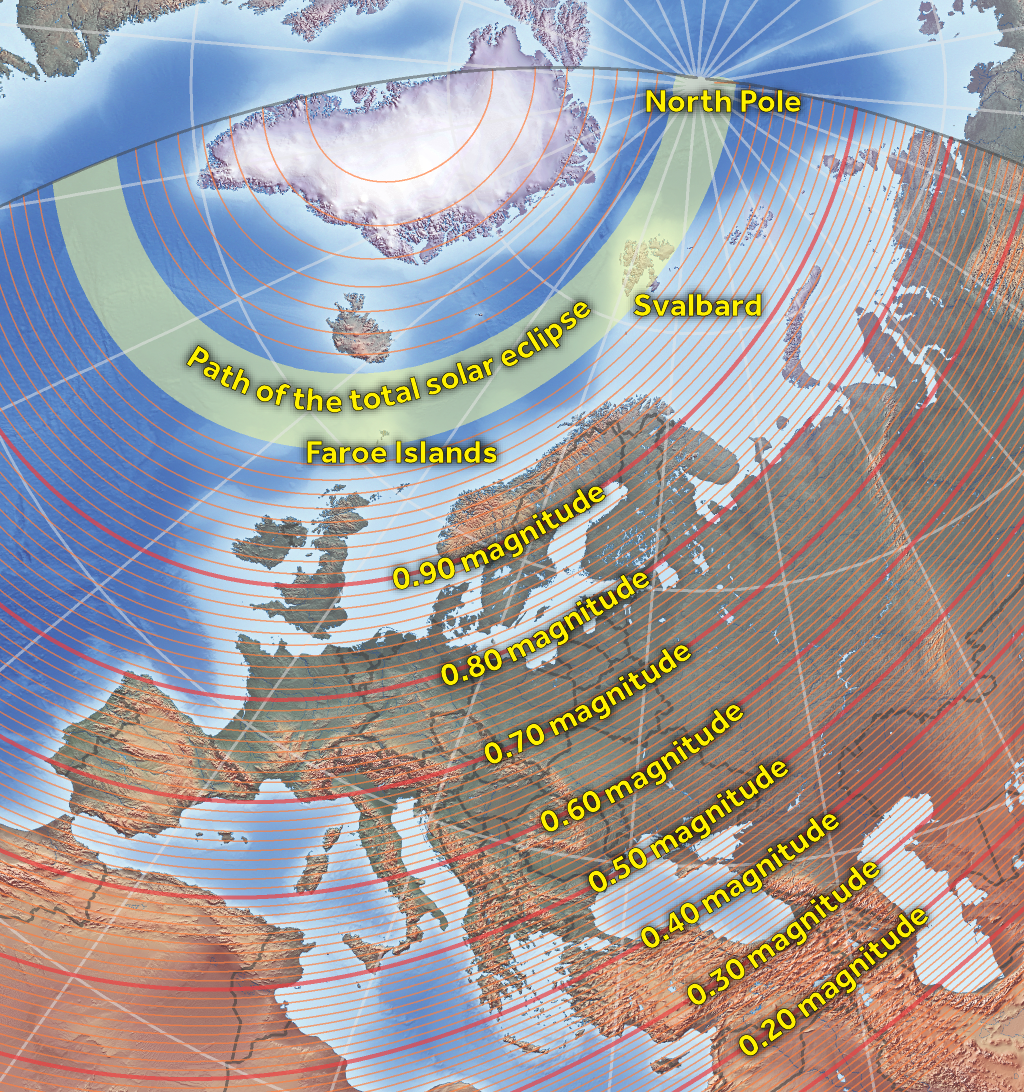
– The only total solar eclipse of 2015 on March 20th, crossing the high Arctic.

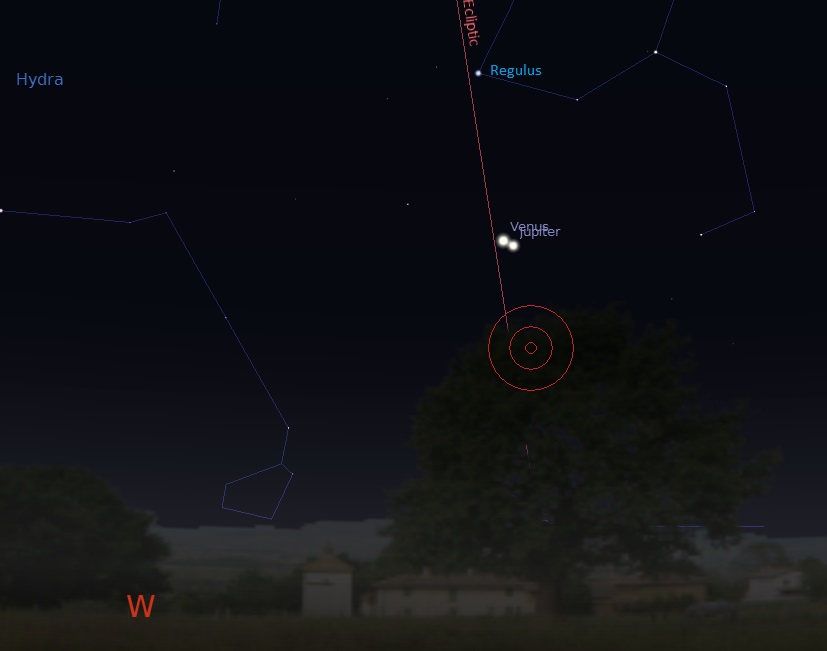
– A fine dusk pairing of the bright planets Jupiter and Venus on July 1st.

– Possible wildcard outbursts from the Alpha Monocerotid and Taurid meteors, and a favorable New Moon near the peak of the August Perseids.

– Possible naked eye appearances by comet Q2 Lovejoy opening 2015 and comet US10 Catalina later in the year.

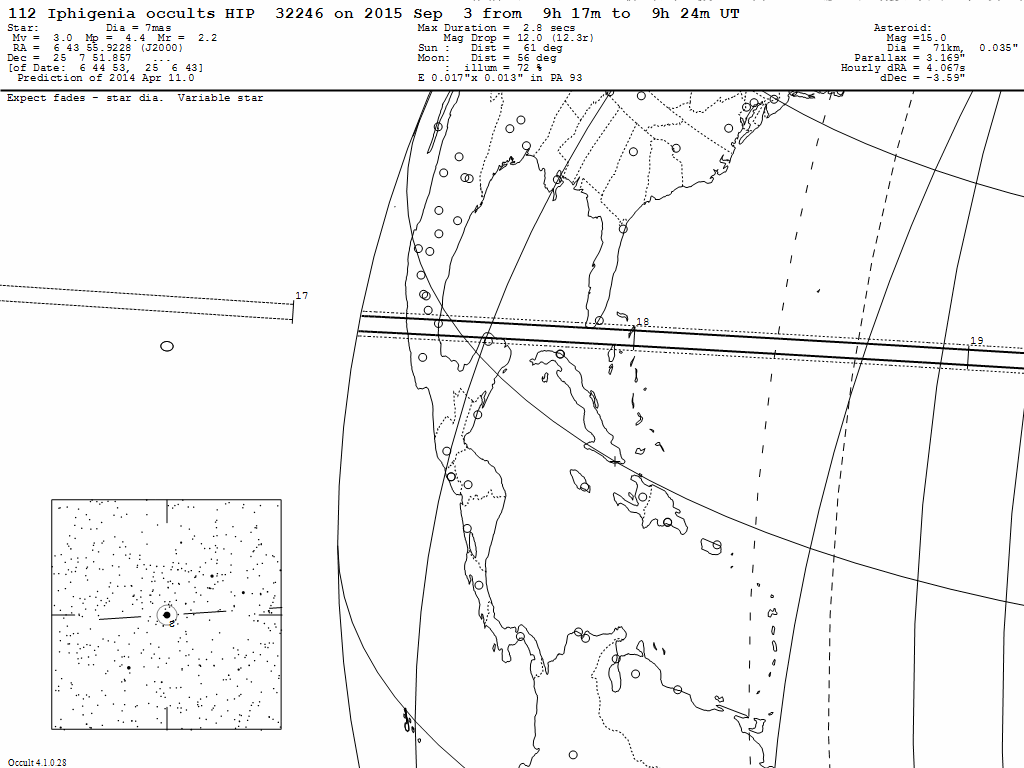
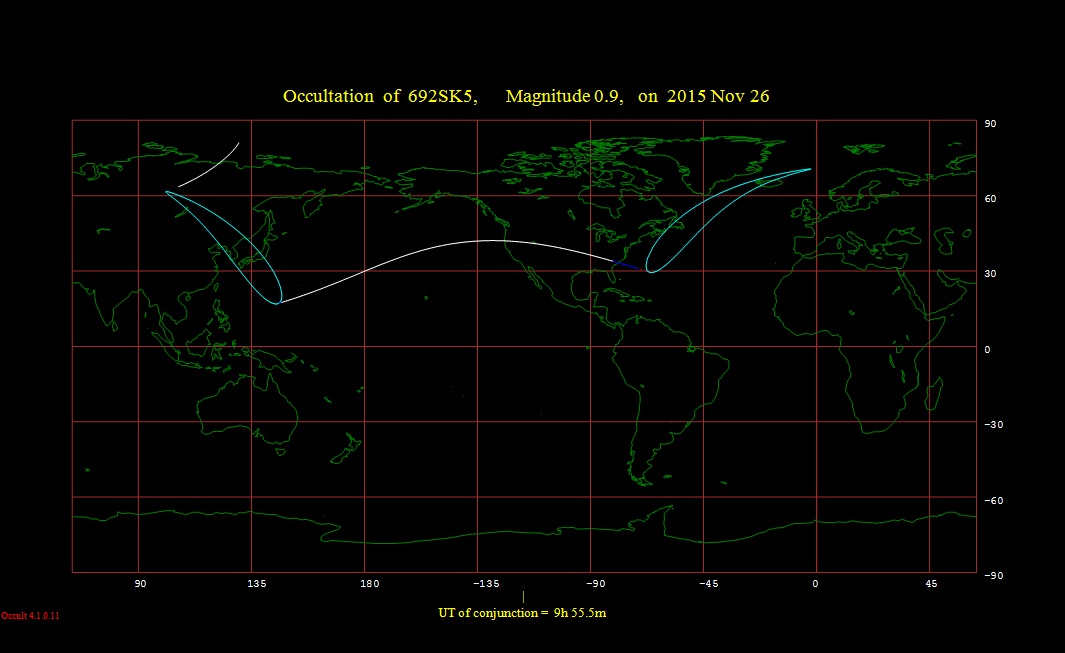
– The occultation of a naked eye star for Miami by an asteroid on September 3rd.

– A series of fine occultations by the Moon of bright star Aldebaran worldwide.

The rules: The comprehensive list that follows has been lovingly distilled down to the top 101 astronomical events for 2015 worldwide. Some, such as lunar eclipses, are visible to a wide swath of humanity, while others, such as many of the asteroid occultations or the sole total solar eclipse of 2015 happen over remote locales. We whittled the list down to a "Top 101" using the following criterion:

Meteor showers: Must have a predicted ZHR  greater than 10.

Conjunctions: Must be closer than one degree.

Asteroid occultations: Must have a probability ranking better than 90 and occult a star brighter than magnitude +8.

Comets: Must reach a predicted brightness greater than magnitude +10. But remember: comets don't always read prognostications such as this, and may over or under perform at whim… and the next big one could come by at any time!

Times quoted are geocentric unless otherwise noted, and are quoted in Universal Time in a 24- hour clock format.

These events are meant to merely whet the appetite. Expect 'em to be expounded on fully by Universe Today as they approach. We linked to the events listed where possible, and provided a handy list of resources that we routinely consult at the end of the article.

Got it? Good… then without further fanfare, here's the top 101 astronomical events for 2015 in chronological order:

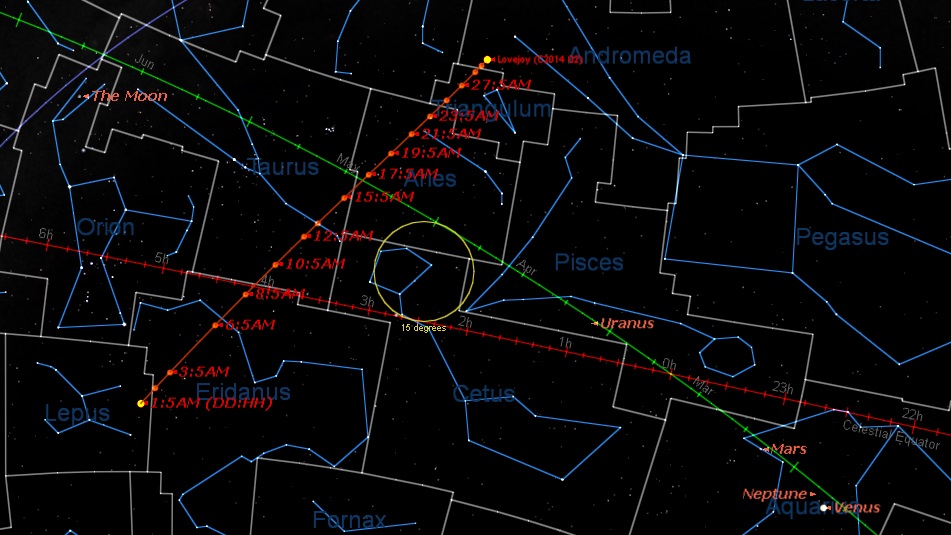
The path of Comet Q2 Lovejoy From January 1st to January 31st.

The path of Comet Q2 Lovejoy from January 1st to January 31st. Created using Starry Night Education software.

January

01- Comet C/2012 Q2 Lovejoy may reach naked eye visibility.

04- The Quadrantid meteors peak at 02:00 UT, favoring northern Europe with an expected ZHR of 120.

04- The Earth reaches perihelion at ~8:00 UT.

14- Mercury reaches greatest evening elongation 18.9 degrees east of the Sun at ~16:00 UT.

17- The moons Io and Europa cast a double shadow on Jupiter from 3:53 to 4:58 UT.

20- Mars passes 0.2 degrees from Neptune at ~20:00 UT.

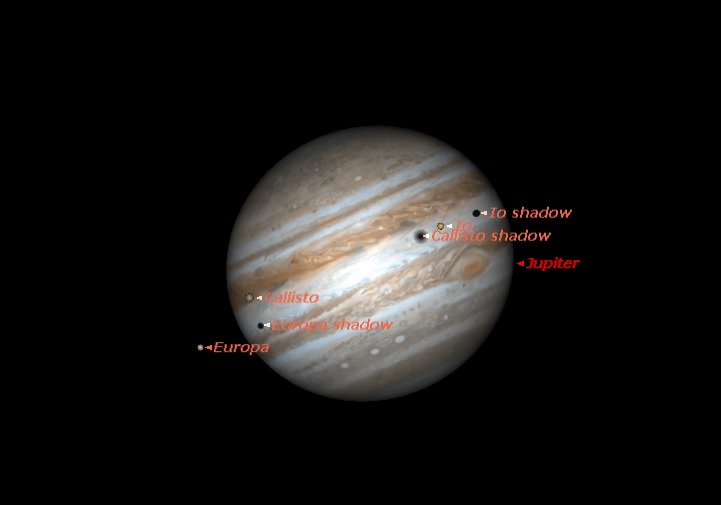
24- A triple shadow transit of Jupiter's moons occurs from 6:26 to 6:54 UT.

29- The Moon occults Aldebaran at ~17:31 UT for the Arctic, marking the first of 13 occultations of the star by the Moon in 2015.

The view at 6:40 UT.

The view at 6:40 UT on January 24th, as 3 of Jupiter's moons cast shadows on to the Jovian cloud tops simultaneously. Created using Starry Night Education software.

February

01- Venus passes 0.8 degrees south of Neptune at ~17:00 UT.

05- Earth crosses through Jupiter's equatorial plane, marking the middle of occultation and eclipse season for the Galilean moons.

06- Jupiter reaches opposition at ~18:00 UT.

18- A "Black Moon" occurs, in the sense of the third New Moon in a season with four.

22- Venus passes 0.4 degrees south of Mars at 5:00 UT.

24- Mercury reaches greatest morning elongation at 26.7 degrees west of the Sun at 19:00 UT.

25- The Moon occults Aldebaran for northern Europe at 23:26 UT.

Credit: Eclipse-Maps

The path of the only total solar eclipse of 2015, occurring on March 20th. Credit: Michael Zeiler/Eclipse-Maps.

March

01- Geostationary satellite & Solar Dynamics Observatory eclipse season begins on the weeks leading up to the March Equinox.

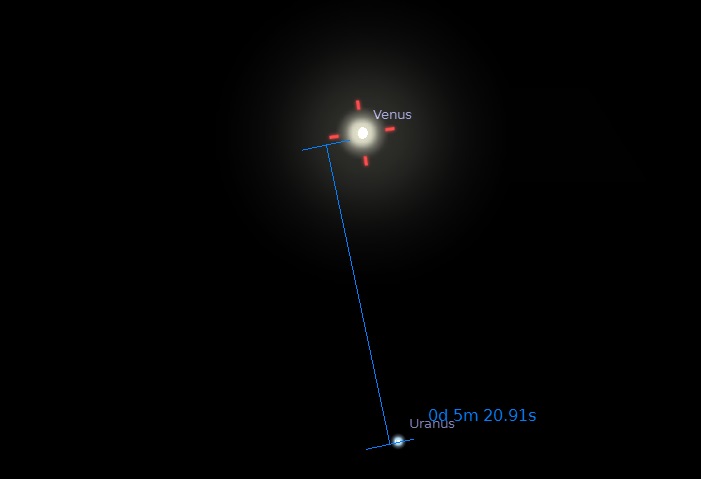
04- Venus passes 0.1 degrees north of Uranus at ~18:00 UT. This is the closest planet-planet conjunction of 2015.

05- A Minimoon occurs, marking the most distant Full Moon of 2015 at 18:07 UT, just 10 hours from apogee.

11- Mars passes 0.3 degrees north of Uranus at ~16:00 UT.

20- A total solar eclipse occurs over the Arctic centered on 9:47 UT.

20- The March northward equinox occurs at 16:57 UT.

21- The Moon occults Mars for South America at ~22:14 UT.

25- The Moon occults Aldebaran for northwestern North America at ~7:17 UT.

Stellarium

Neith lives… the close passage of Uranus near Venus on March 4th. Credit: Stellarium.

April

04- A total lunar eclipse occurs, centered on 12:01 UT and visible from eastern Asia, the Pacific and the Americas.

08- Mercury passes 0.5 degrees from Uranus at ~11:00 UT.

21- The Moon occults Aldebaran for northern Asia at ~16:57 UT.

22- The Lyrid meteors peak at 24:00 UT, favoring northern Europe with a ZHR of 18.

May

05- The Eta Aquarid meteors peak (time variable), with an estimated ZHR of 55.

07- Mercury reaches greatest evening elongation at 21.2 degrees east of the Sun at 4:00 UT.

19- The Moon occults Aldebaran for northern North America at ~2:53 UT .

20- Comet C/2014 Q1 PanSTARRS may reach binocular visibility.

20- Io and Ganymede both cast shadows on Jupiter from 22:04 to 22:33 UT.

21- Callisto and Europa both cast shadows on Jupiter from 11:26 to 11:59 UT.

23- Saturn reaches opposition at ~1:00 UT.

28- Ganymede and Io both cast shadows on Jupiter from 00:01 to 2:18 UT.

30- Comet 19P/Borrelly may reach binocular visibility.

June

01- The International Space Station reaches full illumination as the June solstice nears, resulting in multiple nightly passes favoring  northern hemisphere observers.

04- Io and Ganymede both cast shadows on Jupiter from 2:54 to 4:13 UT.

05- Venus reaches greatest eastern (dusk) elongation for 2015, 45 degrees from the Sun at 16:00 UT.

10- Asteroid 424 Gratia occults a +6.1 magnitude star at ~15:10 UT for northwestern Australia.

15- The Moon occults Mercury for the South Indian Ocean at ~2:26 UT.

15- Moon occults Aldebaran in the daytime for the high Arctic at ~11:33 UT.

16- Comet C/2014 Q1 PanSTARRS may reach naked eye visibility.

21- The June northward solstice occurs at 10:51 UT.

24- Mercury reaches greatest (morning) elongation at 22.5 degrees west of the Sun at 17:00 UT.

Stellarium

Venus and Jupiter pair together low in the west on July 1st. Credit: Stellarium.

July

01- Venus passes 0.4 degrees from Jupiter at 9:00 UT, marking the closest conjunction of two naked eye planets for 2015.

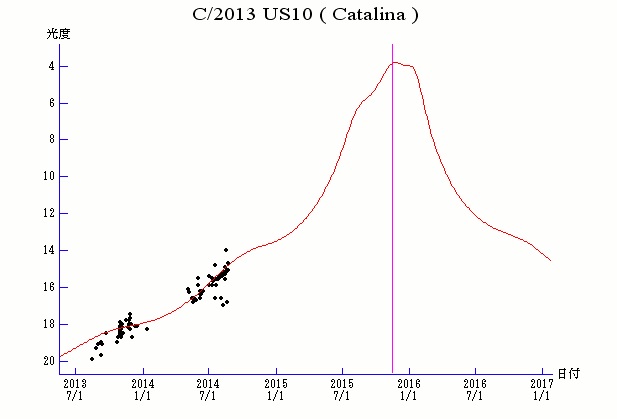
02- Comet C/2013 US10 Catalina may reach binocular visibility.

06- Earth reaches aphelion at 13:00 UT.

06- Pluto reaches opposition at 15:00 UT, just a week prior to New Horizons' historic flyby of the distant world.

12- The Moon occults Aldebaran for northeastern Asia ~18:17 UT.

19- The Moon occults Venus for the South Pacific at ~1:07 UT.

25- Asteroid 49 Pales occults a +6.6 magnitude star at 10:55 UT for Mexico.

28- The Delta Aquarids peak (time variable) with a predicted ZHR of 16.

31- A "Blue Moon" occurs, in the sense of the second Full Moon in a given month.

Credit:

The light curve of comet C/2013 US10 Catalina through its peak in 2015. Credit: Seiichi Yoshida's Weekly Information About Bright Comets.

August

07- Mercury, Jupiter and Regulus pass within a degree of each other over the next few mornings.

08- The Moon occults Aldebaran for central Asia at ~23:45 UT.

13- The Perseid meteors peak from 06:30 to 09:00 UT, with a maximum predicted ZHR of 100 favoring North America.

19- Mars crosses the Beehive Cluster M44.

28- Asteroid 16 Psyche occults a +6.4 magnitude star at ~9:49 UT for Bolivia and Peru.

29- Supermoon 1 of 3 for 2015: The Moon reaches Full at 18:38 UT, 20 hours from Full.

Lunar eclipse

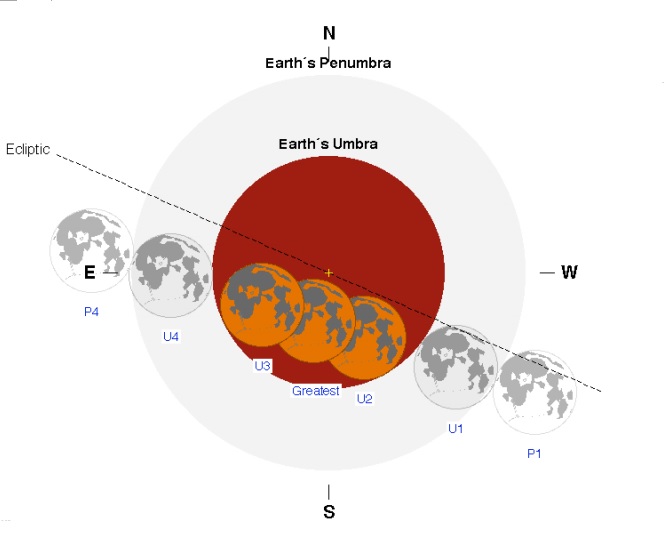
The path of the Moon through the Earth's shadow on September 28th. Credit: Fred Espenak/NASA/GSFC

September

01- Neptune reaches opposition at ~3:00 UT.

03- Asteroid 112 Iphigenia occults a +3rd magnitude star for Mexico and Miami at ~9:20 UT. This is the brightest star occulted by an asteroid in 2015.

02- Geostationary satellite and SDO eclipse season begins as we approach the September equinox.

04- Mercury reaches its greatest elongation for 2015, at 27 degrees east of the Sun at 8:00 UT in the dusk skies.

05- The Moon occults Aldebaran for northeastern North America at ~5:38 UT.

13- "Shallow point" (also known as the minor lunar standstill) occurs over the next lunation, as the Moon's orbit reaches a shallow minimum of 18.1 degrees inclination with respect to the celestial equator… the path of the Moon now begins to widen towards 2025.

13- A partial solar eclipse occurs, centered on 6:55 UT crossing Africa and the Indian Ocean.

23- The September southward equinox occurs at 2:29 UT.

25- Mars passes 0.8 degrees from Regulus at ~4:00 UT.

28- A total lunar eclipse occurs centered on 2:48 UT, visible from the Pacific, the Americas and eastern Europe.

28- Supermoon 2 of 3 for 2015: The Moon reaches Full at 2:52 UT, approximately an hour from Full. This marks the closest Full Moon of the year.

Credit

The path of the September 3rd occultation of a +3rd magnitude star by an asteroid over central Mexico and the Florida Keys. Credit: IOTA/Steve Preston.

October

01- Comet C/2013 US10 Catalina may reach naked eye visibility.

02- The Moon occults Aldebaran for the northern Pacific at 13:14 UT.

02- Io and Callisto both cast shadows on Jupiter from 10:26-11:35 UT.

08- The Moon occults Venus for Australia at ~20:32 UT.

11- The Moon occults Mercury for Chile at ~12:00 UT.

12- Uranus reaches opposition at ~3:00 UT.

16- Mercury reaches greatest elongation (morning) 18.1 degrees west of the Sun at 10:00 UT.

17- Mars passes 0.4 degrees from Jupiter at 22:00 UT.

18- Io and Ganymede both cast shadows on Jupiter from 8:45 to 10:10 UT.

21- The Orionid meteors peak (time variable) with a projected ZHR of 15.

25- Venus passes 1 degree from Jupiter ~19:00 UT.

25- Io and Ganymede both cast shadows on Jupiter from 10:37 to 12:51 UT.

27- Supermoon 3 of 3 for 2015: The Moon reaches Full at 12:06 UT, 23 hours from Full.

29- The Moon occults Aldebaran for Europe at ~23:07 UT.

Credit

The Moon occults Aldebaran: the visibility footprint for North America. The dashed line denotes the area in which the event occurs during the daytime. Credit: Occult 4.1.0.11.

November

01- Io and Ganymede both cast shadows on Jupiter from 15:36 to 15:47 UT.

02- Venus passes 0.7 degrees south of Mars at 00:30 UT.

12- Will the 7 year "Taurid fireball meteor shower" produce?

18- The Leonid meteor shower peaks at 04:00 UT, with an estimated ZHR of 15 favoring Europe.

22- Are we in for a once per decade Alpha Monocerotids outburst? The 2015 peak arrives at 4:25 UT, favoring Europe… with a max ZHR = 400+ possible.

26- The Moon occults Aldebaran for North America at ~9:56 UT.

29- Comet C/2013 X1 PanSTARRS may reach binocular visibility.

Occultation

The daytime occultation of Venus by the Moon over North America on December 7th. Credit: Occult 4.1.0.11.

December

01- The International Space Station reaches full illumination as the December solstice nears, resulting in multiple nightly passes favoring the  southern hemisphere.

04- Mercury occults the +3.3 magnitude star Theta Ophiuchi for South Africa at 16:16 UT prior to dusk.

06- The Moon occults Mars for central Africa at ~2:42 UT.

07- The Moon occults Venus in the daytime for North America at ~16:55 UT.

14- The Geminid meteor shower peaks at 18:00 UT, with a ZHR=120 favoring NE Asia.

21- The December southward solstice occurs at 23:03 UT.

23- The Ursid meteor shower peaks at 2:30 UT with a ZHR variable from 10-50 favoring Europe and the Middle East.

23- The Moon occults Aldebaran for Europe and central Asia at ~19:32 UT.

29- Mercury reaches greatest evening elongation at 19.7 degrees east of the Sun at 00:01 UT.


Didn't see your favorite event on the list? Let us know, and be sure to send in any images of these fine events to Universe Today's Flickr forum.

Enjoy another exciting year of space and astronomy… we'll be expounding on these events and more as 2015 unfolds.

Sources:

Occult 4.0

-Kevin McGill's outstanding astronomical simulations.

-Greatest Elongations of Mercury and Venus.

-Stellarium

-Starry Night Pro

-Orbitron

-Steve Preston's asteroid occultation predictions for 2015.

-The USNO forecast of phenomena for 2015.

-Seiichi Yoshida's Weekly Information About Bright Comets.

-Fred Espenak's NASA Eclipse web page.

-The American Meteor Society's 2015 predictions.

-The International Meteor Organization's 2015 page.

-Fourmilab's lunar perigee and apogee calculator.


About David Dickinson

David Dickinson is an Earth science teacher, freelance science writer, retired USAF veteran & backyard astronomer. He currently writes and ponders the universe from Tampa Bay, Florida.


Fwd: Top Space Stories of 2014


Sent from my iPad

Begin forwarded message:

From: "Gary Johnson" <gjohnson144@comcast.net>
Date: December 24, 2014 at 9:30:15 AM CST
To: "Gary Johnson" <gjohnson144@comcast.net>
Subject: FW: Top Space Stories of 2014


Universe Today's Top 10 Space Stories of 2014

by Elizabeth Howell on December 23, 2014


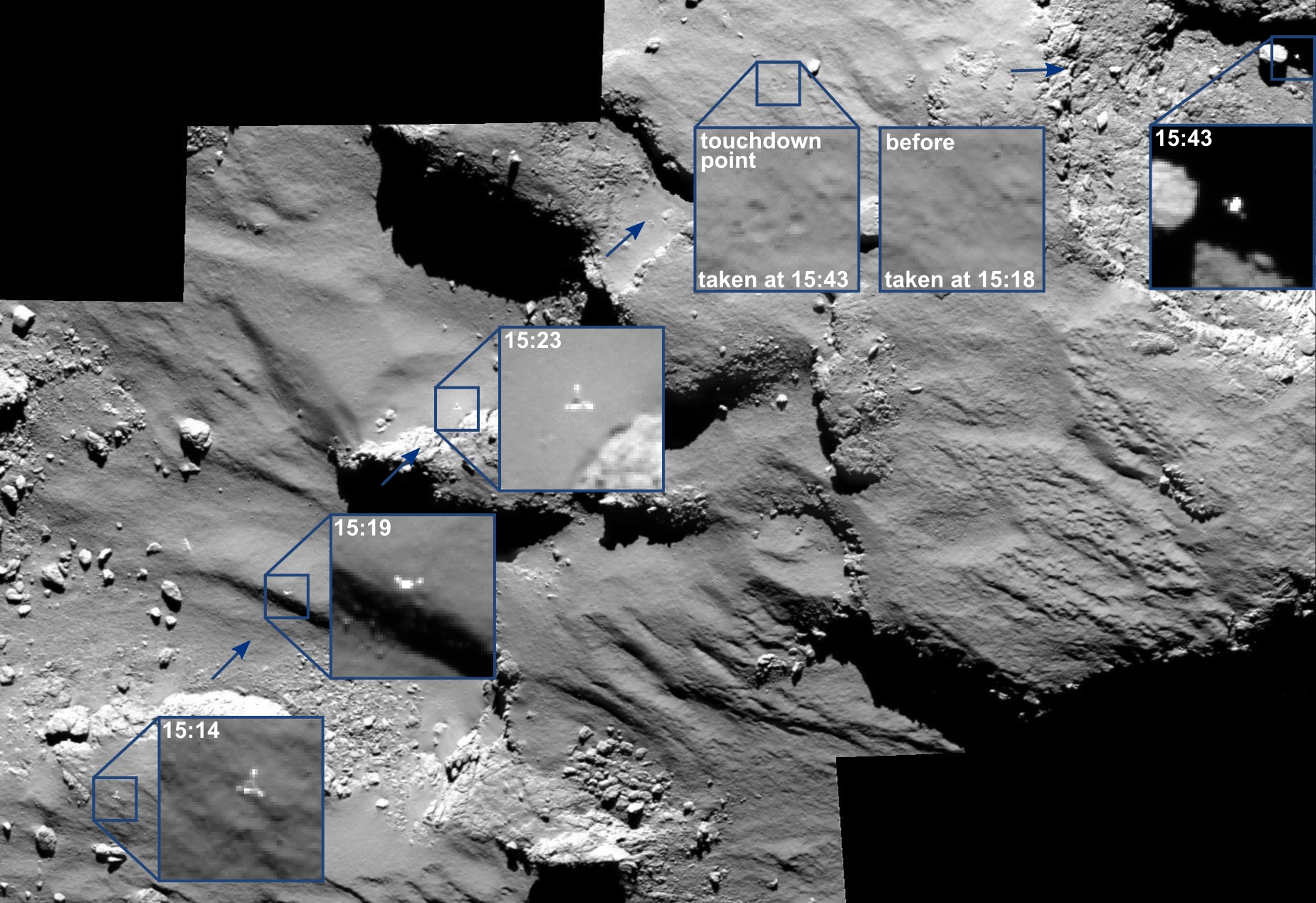
Images from the Rosetta spacecraft show Philae drifting across the surface of its target comet during landing Nov. 12, 2014. Credit: ESA/Rosetta/MPS for OSIRIS Team MPS/UPD/LAM/IAA/SSO/INTA/UPM/DASP/IDA

Images from the Rosetta spacecraft show Philae drifting across the surface of its target comet during landing Nov. 12, 2014. Credit: ESA/Rosetta/MPS for OSIRIS Team MPS/UPD/LAM/IAA/SSO/INTA/UPM/DASP/IDA

It seems a lot of the space stories of this year involve spacecraft making journeys: bouncing across a comet, or making their way to Mars. Private companies also figure prominently, both in terms of successes and prominent failures.

These are Universe Today's picks for the top space stories of the year. Disagree? Think we forgot something? Let us know in the comments.

10. End of Venus Express

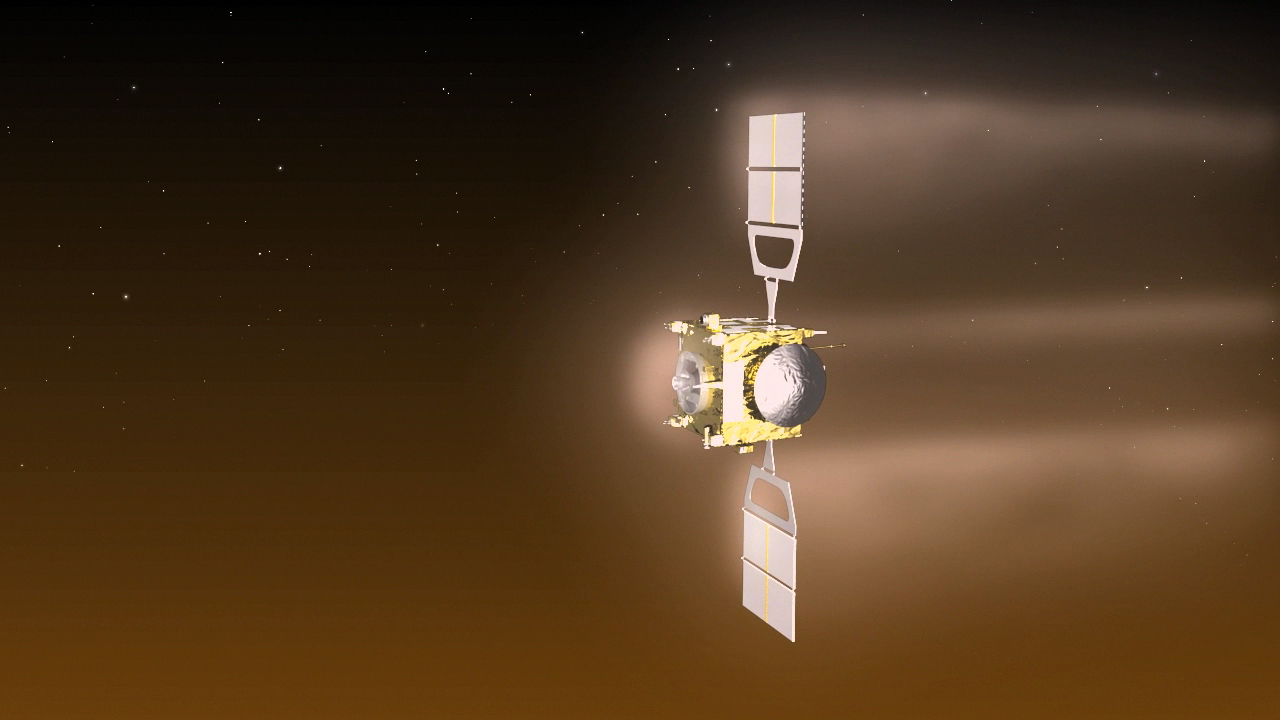
Artist's impression of Venus Express performing aerobreaking maneuvers in the planet's atmosphere in June and July 2014. Credit: ESA–C. Carreau

Artist's impression of Venus Express performing aerobreaking maneuvers in the planet's atmosphere in June and July 2014. Credit: ESA–C. Carreau

This month saw the end of Venus Express' eight-year mission at the planet, which happened after the spacecraft made a daring plunge into part of the atmosphere to learn more about its properties. The spacecraft survived the aerobraking maneuvers, but ran out of fuel after a few engine burns to raise it higher. Soon it will plunge into the atmosphere for good. But it was a productive mission overall, with discoveries ranging from a slowing rotation to mysterious "glories".

9. Continued discoveries by Curiosity and Opportunity

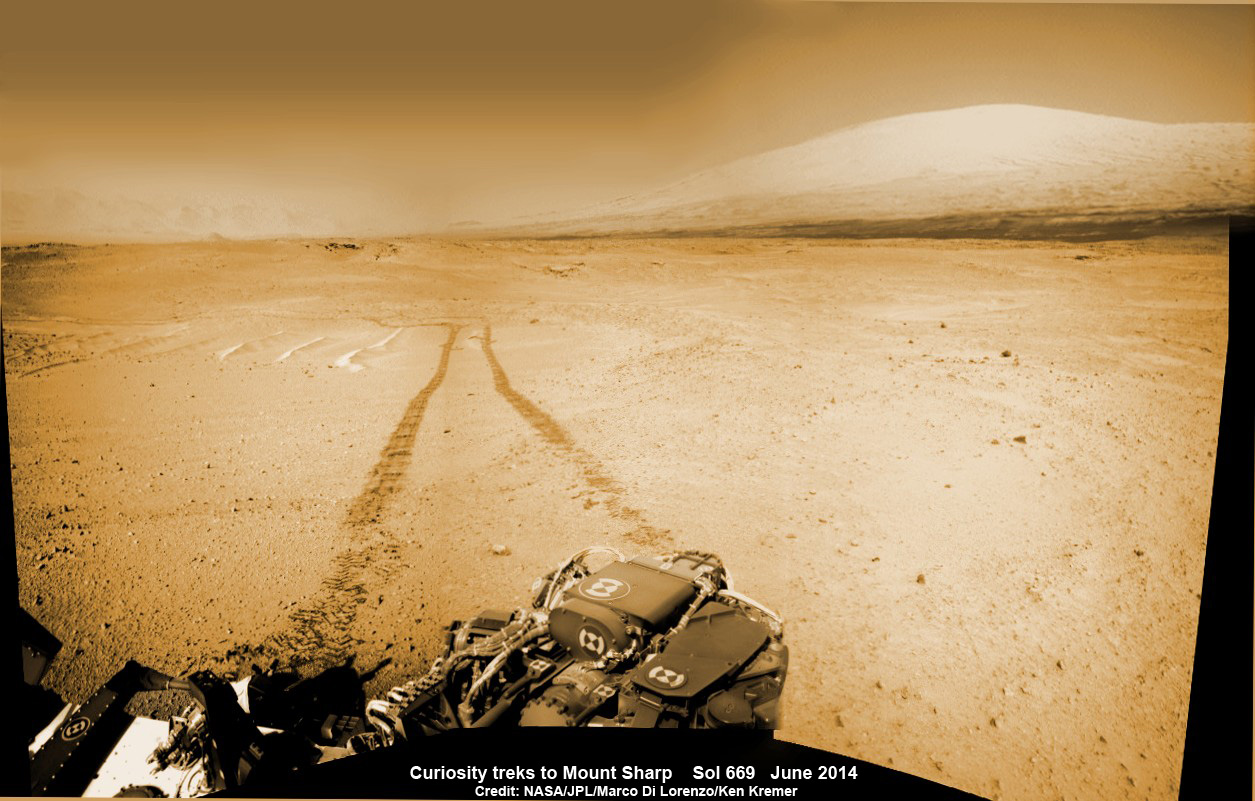
1 Martian Year on Mars!  Curiosity treks to Mount Sharp in this photo mosaic view captured on Sol 669, June 24, 2014.    Navcam camera raw images stitched and colorized.   Credit: NASA/JPL-Caltech/Marco Di Lorenzo/Ken Kremer – kenkremer.com

1 Martian Year on Mars! Curiosity treks to Mount Sharp in this photo mosaic view captured on Sol 669, June 24, 2014. Navcam camera raw images stitched and colorized. Credit: NASA/JPL-Caltech/Marco Di Lorenzo/Ken Kremer – kenkremer.com

Methane? Organics? Water? Mars appears to have had these substances in abundance over its history. Continued work from the Curiosity rover — passing its second Earth year on Mars — found methane fluctuating in Gale Crater, and the first confirmed discovery of organics on the Martian surface. Opportunity is almost 11 years into its mission and battling memory problems, but the rover is still on the move (passing 41 kilometers) to an area that could be full of clay.

8. Siding Spring at Mars and the level of study of the comet by other missions at Mars

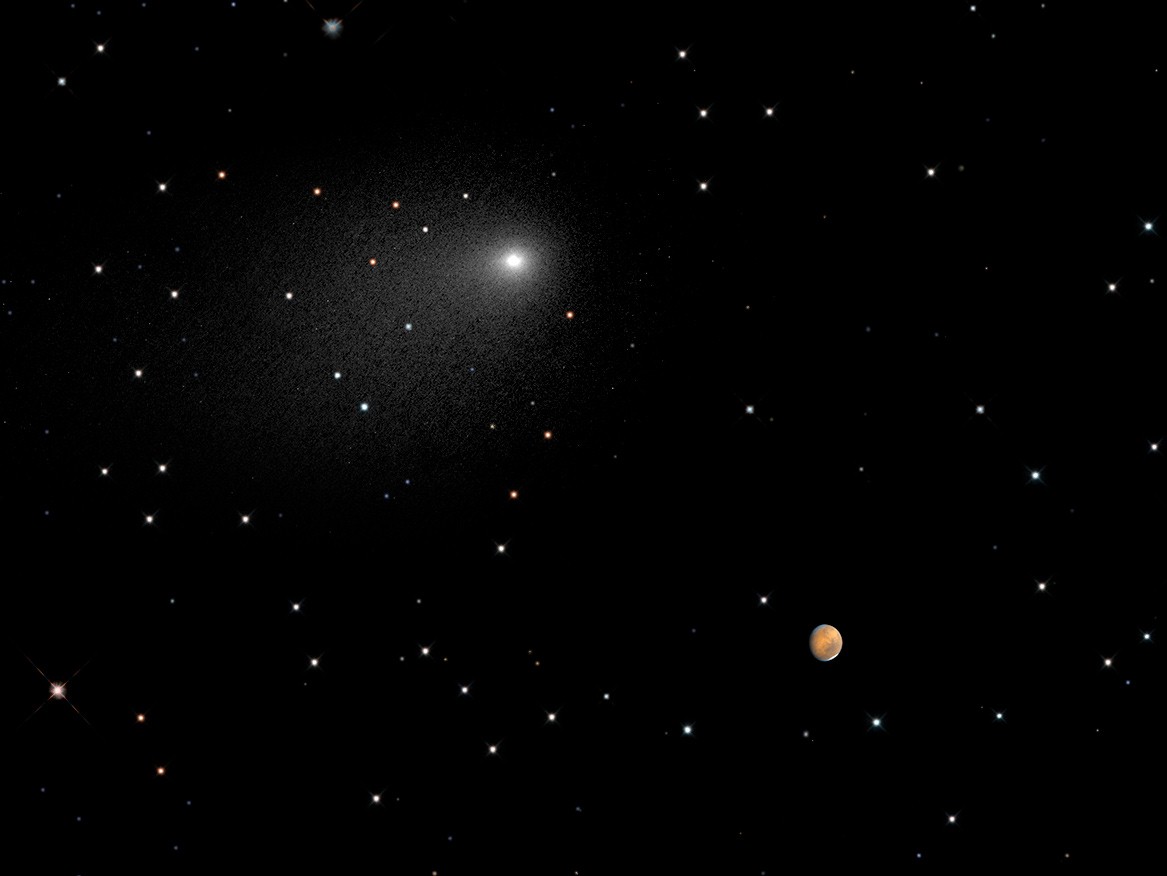
Comet Siding Spring near Mars in a composite image by the Hubble Space Telescope, capturing their positions between Oct. 18 8:06 a.m. EDT (12:06 p.m. UTC) and Oct. 19 11:17 p.m. EDT (Oct. 20, 3:17 a.m. UTC). Credit: NASA, ESA, PSI, JHU/APL, STScI/AURA

Comet Siding Spring near Mars in a composite image by the Hubble Space Telescope, capturing their positions between Oct. 18 8:06 a.m. EDT (12:06 p.m. UTC) and Oct. 19 11:17 p.m. EDT (Oct. 20, 3:17 a.m. UTC). Credit: NASA, ESA, PSI, JHU/APL, STScI/AURA

We had a rare opportunity to watch a comet make a grazing pass by Mars, not close enough to pose significant danger to spacecraft, but definitely close enough to affect its atmosphere! Siding Spring caught everyone's attention throughout the year, and did not disappoint. The numerous spacecraft at the Red Planet caught glimpses, including from the surface and from orbit. It likely created a meteor shower and could alter the Martian atmosphere forever.

7. Kepler K2

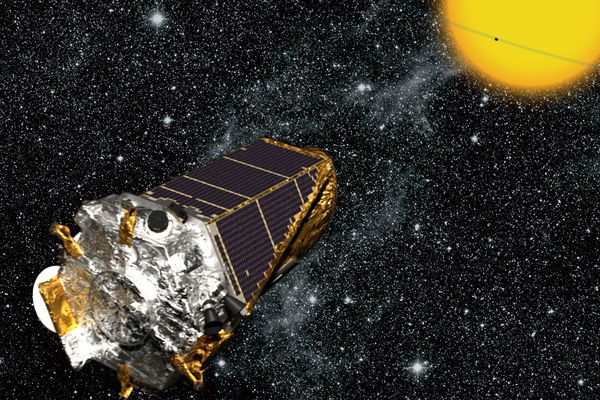
Illustration of the Kepler spacecraft (NASA/Kepler mission/Wendy Stenzel)

Illustration of the Kepler spacecraft (NASA/Kepler mission/Wendy Stenzel)

The Kepler space telescope lost the second of its four pointing devices last year, requiring a major rethink for the veteran planet hunter. The solution was a new mission called K2 that uses the pressure of the Sun to maintain the spacecraft's direction, although it has to flip every 83 days or so to a new location to avoid the star's glare. It's not as precise as before, but with the mission approved we now know for sure K2 can locate exoplanets. The first confirmed one is a super-Earth.

6. MAVEN at Mars

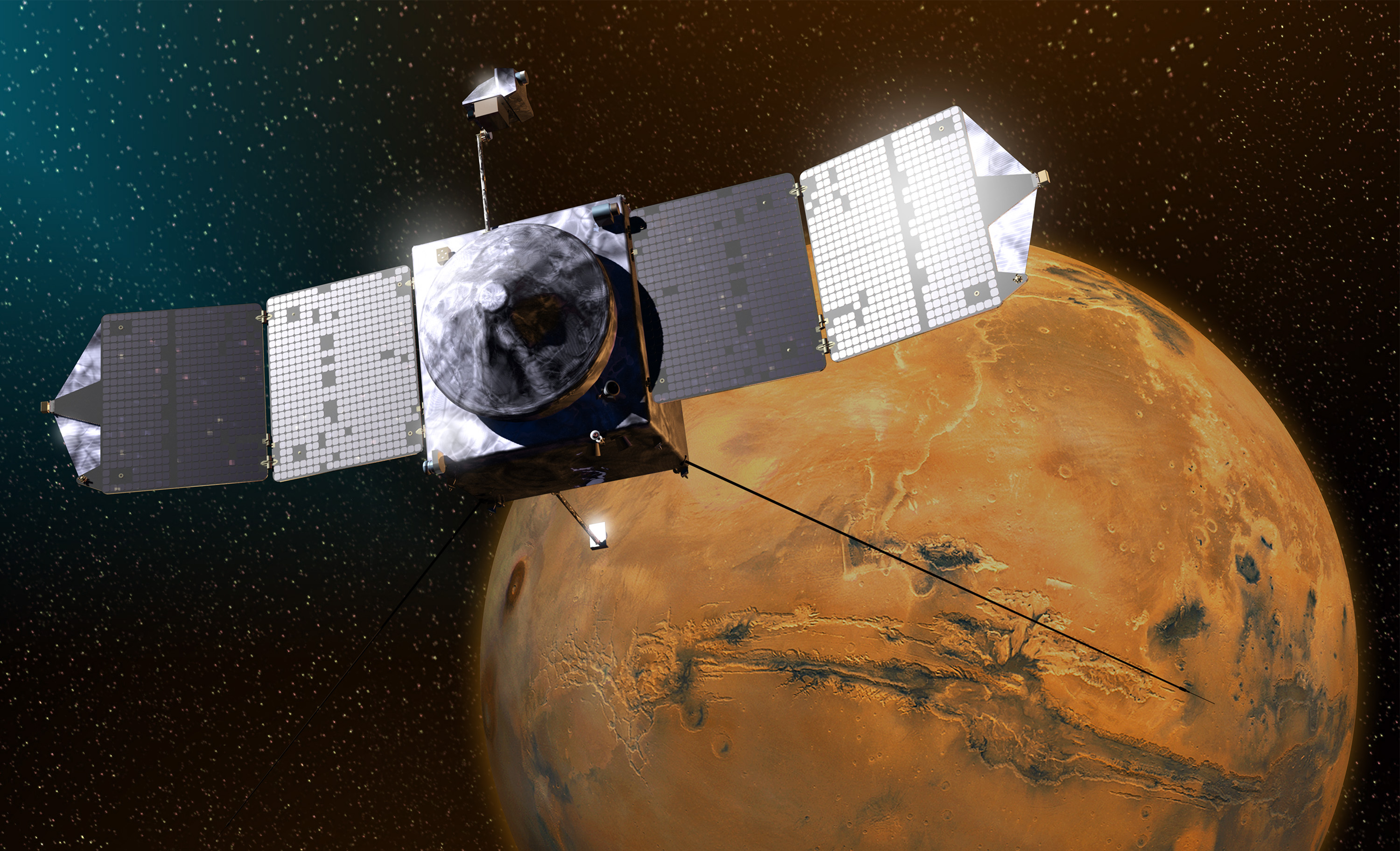
An artist's conception of MAVEN orbiting Mars. Image Credit: NASA / Goddard Space Flight Center

An artist's conception of MAVEN orbiting Mars. Image Credit: NASA / Goddard Space Flight Center

Where did the Martian atmosphere go? Why was it so thick in the past, allowing water to flow on the surface, and so thin right now? The prevailing theory is that the Sun's pressure on the Martian atmosphere pushed lighter isotopes (such as that of hydrogen) away from the planet, leaving heavier isotopes behind. NASA is now investigating this in more detail with MAVEN (Mars Atmosphere and Volatile Evolution), which arrived at the planet this fall.

5. India's MOM

Artist's impression of India's Mars Orbiter Mission (MOM). Credit ISRO

Artist's impression of India's Mars Orbiter Mission (MOM). Credit ISRO

India made history this year as only the third entity to successfully reach the Red Planet (after the United States and Europe). While updates from the Mars Orbiter Mission have been slow in recent weeks, we know for sure that it observed Siding Spring at Mars and it has been diligently taking pictures of the Red Planet, such as this one of the Solar System's largest volcano and a huge canyon on Mars.

4. Accidents by Virgin and Orbital

NTSB investigators are seen making their initial inspection of debris from the Virgin Galactic SpaceShipTwo. The debris field stresses over a fiver mile range in the Mojave desert. (Credit: Getty Images)

NTSB investigators are seen making their initial inspection of debris from the Virgin Galactic SpaceShipTwo. The debris field stresses over a fiver mile range in the Mojave desert. (Credit: Getty Images)

In one sobering week in October, the dangers of space travel were again made clear after incidents affected Virgin Galactic and Orbital Sciences. Virgin lost a pilot and seriously injured another when something went seriously awry during a flight test. Investigators have so far determined that the re-entry system turned on prematurely, but more details are being determined. Orbital meanwhile suffered the catastrophic loss of one of its Antares rockets, perhaps due to Soviet-era-designed engines, but the company is looking at other ways to fulfill its NASA contractual obligations to send cargo to the International Space Station.

3. SpaceX rocket landing attempts

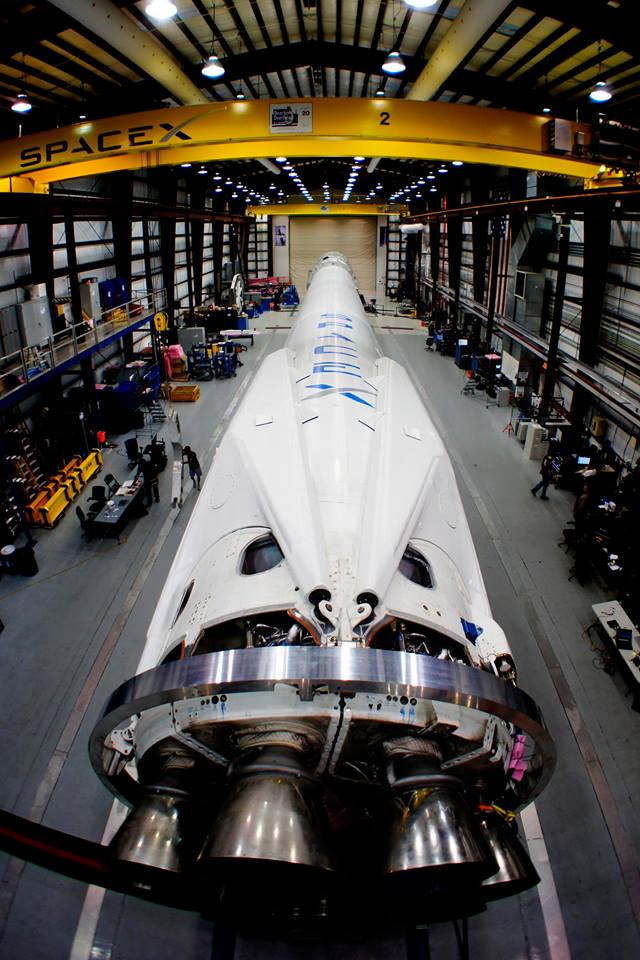
The Falcon 9 rocket with landing legs in SpaceX's hangar at Cape Canaveral, Fl, preparing to launch Dragon to the space station this Sunday March 30.  Credit: SpaceX

The Falcon 9 rocket with landing legs in SpaceX's hangar at Cape Canaveral, Fl, preparing to launch Dragon to the space station this Sunday March 30. Credit: SpaceX

SpaceX is attempting a daunting technological feat, which is bringing back its rocket first stages for re-use. The company is hoping that this will cut down on the costs of launch in the long term, but this technological innovation will take some time. The Falcon 9 rocket stage that made it back to the ocean in July was deemed a success, although the force of the landing broke it apart. Next, SpaceX is trying to place its rocket on an ocean platform.

2. Orion flight

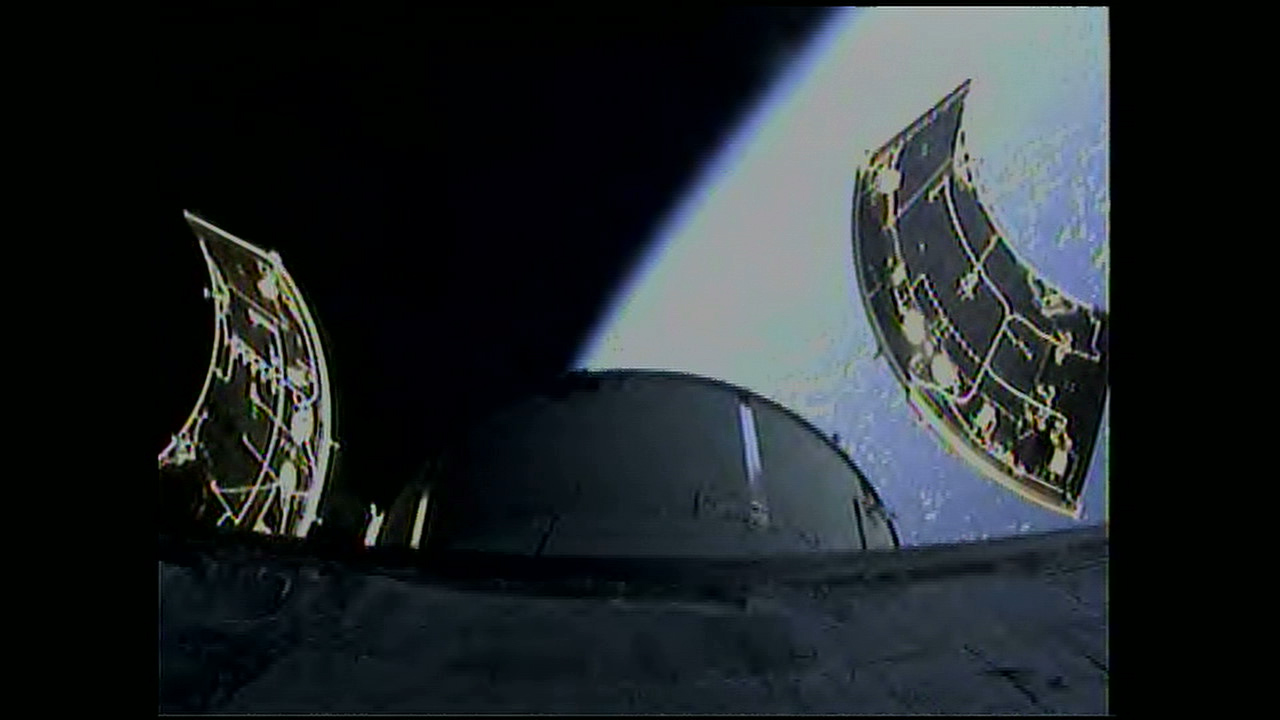
Orion Service Module fairing separation. Credit: NASA TV

Orion Service Module fairing separation. Credit: NASA TV

NASA's spacecraft for deep space exploration (Orion) successfully finished its first major uncrewed test this month, when it rode into orbit, made a high-speed re-entry and successfully splashed down in the ocean. But it's going to be a while before Orion flies again, likely in 2017 or even 2018. NASA hopes to put a crew on this spacecraft type in the 2020s, potentially for trips to the Moon, an asteroid or (more distantly) Mars.

1. Rosetta

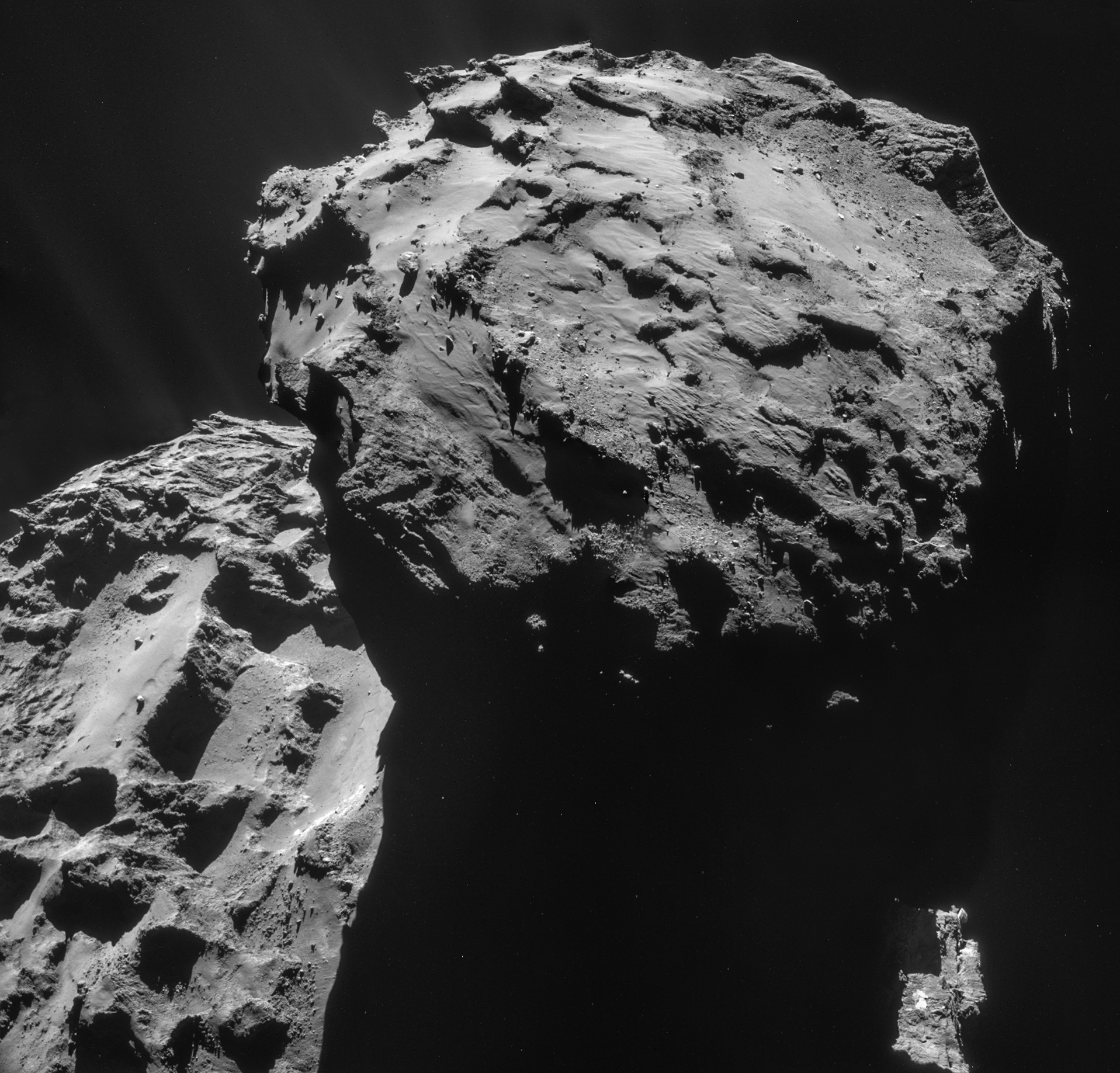
New Rosetta mission findings do not exclude comets as a source of water in and on the Earth's crust but does indicate comets were a minor contribution. A four-image mosaic comprises images taken by Rosetta's navigation camera on 7 December from a distance of 19.7 km from the centre of Comet 67P/Churyumov-Gerasimenko. (Credit: ESA/Rosetta/Navcam Imager)

New Rosetta mission findings do not exclude comets as a source of water in and on the Earth's crust but does indicate comets were a minor contribution. A four-image mosaic comprises images taken by Rosetta's navigation camera on 7 December from a distance of 19.7 km from the centre of Comet 67P/Churyumov-Gerasimenko. (Credit: ESA/Rosetta/Navcam Imager)

It's been an exciting year for the Rosetta mission. First it woke up from a lengthy hibernation, then it discovered that Comet 67P/Churyumov-Gerasimenko looks a bit like a rubber duckie, and then it got up close and released the Philae lander. The soft touchdown did not go as planned, to say the least, as the spacecraft bounced for two hours and then came to rest in a spot without a lot of sunlight. While Philae hibernates and controllers hope it wakes up again in a few months, however, science results are already showing intriguing things. For example, water delivered to Earth likely came mostly from other sources than comets.


The Biggest Astronomy Stories of 2014

by Calla Cofield, Space.com Staff Writer   |   December 23, 2014 04:53pm ET


Exoplanet Kepler-186f

An artist's concept of Kepler-186f, the first Earth-sized planet found orbiting in the habitable zone of its parent star.
Credit: NASA Ames/SETI Institute/JPL-Caltech View full size image

The year 2014 was a packed one for astronomical science.

Over the last 12 months, scientists made historic progress in the study of Mars, had two close encounters with comets, and may have found hints of dark matter and signals from the Big Bang. It's enough to make us eager for 2015 to see what new discoveries await. 

But there are some stories that stand out from the crowd that was space science in 2014. Here is our list of the biggest astronomy stories of the year:

Historic year in Mars exploration

Tantalizing new information about the Red Planet, along with new clues about the possibility that it once supported life, was revealed this year. 2014 also happens to be the 50-year launch anniversary of the first probe ever sent to Mars.

In December, scientists working on the Mars rover Curiosity announced that the Red Planet hosts organic chemicals (those that contain carbon and are the building blocks of life on Earth). The chemicals chlorobenzene, dichloroethane, dichloropropane and dichlorobutane were discovered inside a rock that Curiosity drilled into in May 2013. Researchers stressed that their findings do not indicate that life exists or ever existed on Mars — but it does open the door of possibility.

In addition, scientists confirmed in December that the rover had detected methane on Mars, despite not finding any trace of methane last year. Living organisms on Earth are known to produce high levels of methane, so its presence on the Red Planet is another possible sign of life.

NASA's Mars Atmosphere and Volatile Evolution (MAVEN) spacecraft arrived at the Red Planet on Sept. 21, just in time to observe the flyby of Comet Siding Spring. The $671 million mission will focus on uncovering the events that changed the planet from a world with lakes and rivers, to a complete desert.

Just two days after MAVEN, India's Mars Orbiter Mission (MOM) arrived at the fourth planet from the sun. The $74 million mission is India's first probe to reach Mars. MOM is carrying a camera (and has already snapped some stunning photos), and four scientific instruments that will study the planet's surface and atmosphere.

The swarm of activity around Mars came during the 50-year anniversary of the launch of the Mariner 4 spacecraft in 1964. Mariner 4 was the first probe to ever fly by Mars and the first mission to take up-close images of another planet from deep space. In celebration of the anniversary, the space-funding company Uwingu used radio telescopes to beam nearly 90,000 messages straight at the Red Planet. 

Cosmic Microwave Background Radiation

An image of the cosmic microwave background radiation, taken by the European Space Agency (ESA)'s Planck satellite in 2013, shows the small variations across the sky
Credit: ESA/Planck Collaboration

View full size image

Big Bang discovery bites the dust

The BICEP2 collaboration grabbed headlines in March when it claimed to have found evidence that our universe rapidly expanded after the Big Bang, causing ripples in the fabric of the universe. By September, outside evaluation had thrown serious doubt on the findings. 

BICEP2 (which stands for the Background Imaging of Cosmic Extragalactic Polarization) uses a telescope in Antarctica to detect the light left over from the Big Bang, called the cosmic microwave background (CMB). Patterns in that light that are very difficult to detect could indicate that the universe rapidly expanded shortly after the Big Bang and that the expansion created gravitational waves, or ripples in space-time.

In September, scientists working with the European Space Agency's (ESA) Planck satellite, which also studies the CMB, showed that what BICEP2 interpreted as patterns in the light could be nothing more than gas and dust in the Milky Way. The biggest cosmological finding of the 21st century seemed to crumble.

Now, BICEP2 and Planck will directly compare their data, to try to make a more definitive statement about the results. It is still possible that BICEP2's original interpretation is correct. [BICEP2 and the Origins of the Universe: Behind the Buzz]

Europe's Philae lander took this panorama from the surface of Comet 67P/Churyumov–Gerasimenko after its historic touchdown on Nov. 12, 2014. Philae's body is superimposed on the image.

Europe's Philae lander took this panorama from the surface of Comet 67P/Churyumov–Gerasimenko after its historic touchdown on Nov. 12, 2014. Philae's body is superimposed on the image.
Credit: ESA/Rosetta/Philae/CIVA

View full size image

First touchdown on a comet

In a historic first, ESA landed a probe on a comet. The Philae lander managed to conduct a brief study of the space rock before it lost power and went into hibernation mode.

Philae's mother ship Rosetta spacecraft traveled for 10 years and about 4 billion miles (6.4 billion kilometers) to reach Comet 67P/Churyumov-Gerasimenko. In the early-morning hours of Nov. 12, Philae left Rosetta and traveled the remaining 317 miles (510 km) to the comet. Philae hit the target landing area, but harpoons meant to secure it to the surface did not deploy. Philae bounced twice before settling down for good.

Philae is solar-powered, and the region where it came to rest is in shadow. Unable to recharge, Philae is in hibernation mode.

Before Philae shut down, it did manage to conduct some science. Instruments aboard the lander detected organic molecules — those that contain carbon are a necessary ingredient of life on Earth — in the comet's composition. One of the probe's instruments also made an attempt at hammering into the surface of the comet and found it to be as hard as ice, according to ESA.

"This machine performed magnificently under tough conditions, and we can be fully proud of the incredible scientific success Philae has delivered," Philae lander manager Stephan Ulamec of DLR German Aerospace Agency said in an ESA blog post.

Hubble Views Comet Siding Spring and Mars

A NASA Hubble Space Telescope composite image shows the positions of comet Siding Spring and Mars as the comet streaked by the red planet, at 2:28 p.m. EDT on Oct. 19, 2014.
Credit: NASA, ESA, PSI, JHU/APL, STScI/AURA

View full size image

Mars Siding Spring encounter

Mars experienced a very rare close encounter with a comet in 2014. Comet Siding Spring came within 87,000 miles (139,500 kilometers) of the Red Planet, and left behind a shower of dust for scientists to study.

The five satellites currently orbiting Mars had to batten down the hatches, so to speak, and prepare for the comet to buzz by at a top speed of 126,000 mph (203,000 km/h) relative to the planet. In reality, the probes moved to the opposite side of Mars, which turned out to be a smart move: The comet dumped a few thousand kilograms (about 4,000 lbs.) of material on the planet — far more than scientists had anticipated.

The orbiters were able to study the effect of the massive dust dump, which "literally changed" the Martian atmosphere, according to Jim Green, head of NASA's Planetary Science Division. Scientists say the dust contained high levels of sodium, which would likely have given the sky a yellowish hue as it fell through the Martian atmosphere and burned up. Early analyses also detected iron, zinc, potassium, manganese, nickel and chromium. The dust also contained high levels of magnesium, which was a significant contrast to the Martian atmosphere.  [Mars Myths & Misconceptions: Quiz]

 A comet flies this close to Mars approximately once every 8 million years, according to Green. "We've got a lot of research going on and it's going to be at least another year before all the results are in."

Exoplanet Kepler-186f

An artist's concept of Kepler-186f, the first Earth-sized planet found orbiting in the habitable zone of its parent star.
Credit: NASA Ames/SETI Institute/JPL-Caltech

View full size image

Earth-size planet found in the habitable zone

For the first time, scientists identified an Earth-size planet in the habitable zone of its parent star. The "Earth cousin" could have liquid water and, potentially, the right conditions for life.

The new planet, called Kepler-186f, is less than 10 percent larger than Earth, and orbits a red dwarf star. Red dwarfs are smaller and dimmer than our sun, but the planet still lies in the star's habitable zone — a distance at which the planet could have a surface temperature at which water would remain a liquid.

Kepler-186f is the outermost of five planets orbiting the star Kepler-186, located about 490 light-years from Earth. Scientists think it could be a rocky planet, but they don't yet know if Kepler-186f has an atmosphere suitable for life. As planets become more massive, they become more likely to resemble gas giants like Jupiter, rather than terrestrial planets like Earth and Mars.

Kepler-186f was discovered by the Kepler space telescope. In February, scientists with the Kepler mission announced that they had discovered more than 700 new exoplanets — more than doubling the number of confirmed exoplanets.

Andromeda Galaxy

Astronomers have spotted a possible signal of dark matter in X-rays streaming from the Andromeda galaxy (pictured) and the Perseus galaxy cluster.
Credit: André van der Hoeven

View full size image

Dark-matter signal detected?

It's possible that years from now, 2014 will be remembered as the year dark matter was first detected.

Researchers using data from ESA's XMM-Newton spacecraft reported finding a mysterious X-ray signal coming from both the Andromeda galaxy and the Perseus galaxy cluster. The signal doesn't correspond to any known matter, and the researchers say that one plausible explanation is dark matter.

Dark matter has never been directly detected by scientists (that remains true until the signal from XMM-Newton is confirmed as dark matter). It does not emit, reflect or absorb light (hence the name "dark" matter). But scientists estimate that dark matter makes up 80 percent of the matter in our universe, and it exerts a measureable gravitational force on regular matter like stars and galaxies.

The XMM-Newton results haven't garnered the kind of attention from the scientific community that one might expect for the discovery of the century. Researchers say there are still alternative explanations for the mysterious signal.

Scientists don't know what dark matter is made of, but there are multiple candidate particles. The new results would indicate that dark matter is made of a particle called an axion. Other dark-matter searches are looking for particles called weakly interacting massive particles, or WIMPs.

This year, the U.S. Department of Energy and the U.S. National Science Foundation approved funding for three next-generation dark-matter experiments, which will all be at least 10 times more sensitive than current detectors. The hope is that once these experiments are up and running, an answer to the dark-matter puzzle will be just around the corner.

Borexino Neutrino Detection

Neutrinos produced in a specific fusion process in the heart of the sun were detected by the Borexino detector. The detector's inner shell — a nylon sphere filled with purified benzene — is seen here.
Credit: Borexino Collaboration

View full size image

Solar neutrinos

Scientists are not yet able to look directly into the heart of the sun, but the detection of particles that are produced in the burning core may be the next best thing.

Scientists with the Borexino experiment at Gran Sasso National Laboratory near L'Aquila, Italy, announced in August that they had detected ghostly little particles called neutrinos, produced in the fusion process that keeps the sun burning. The detection confirms scientists' current understanding of stellar fusion.

Neutrinos are particles that pass through regular matter more than 99 percent of the time. Billions of them pass through the palm of your hand every second.

Scientists first detected neutrinos coming from the sun in the 1960s, but those were produced by different processes taking place in Earth's nearest star and tended to have higher energies than the newly detected neutrinos. With higher energies, neutrinos are generally more likely to interact with matter (like a particle detector) and, as a result, are easier to detect.

Because neutrinos rarely interact with regular matter, they escape from the sun instantly, and provided a direct line between the core of the sun and scientists on Earth. Andrea Pocar, of the University of Massachusetts, Amherst and part of the Borexino team, told Space.com by email in August that the neutrinos "allow us to look at the majority of the fusion reactions in the sun's core in real time, as they happen, minus an 8-minute delay for travel to Earth."

The researchers say these particular neutrinos could help them answer other questions, like how neutrinos spontaneously change "flavors."

Filament of the Cosmic Web

The light from the bright quasar UM287 illuminated the 2 million light-year long nebula, which is part of a filament of the cosmic web.
Credit: S. CANTALUPO, UCSC/ W.M. Keck Observatory

View full size image

First glimpse at the cosmic web

This year, scientists got a glimpse at one of the largest structures ever observed in our universe: a thread of the cosmic web, stretching 2 million light-years across the universe.

At very large scales, our universe may resemble a spider web, with long strings of gas stretched between galaxies, connecting them together. This cosmic web hypothesis goes well with theory, but scientists had not seen the intergalactic threads directly until this year.

Using the Keck telescope in Hawaii, the researchers studied the light from an intensely bright object called a quasar, which happened to be pointed at such an angle that it lit up the gas thread between two galaxy nodes. Quasars are powered by material surrounding supermassive black holes, and they shine brighter than all the stars in their host galaxy combined.

"The quasar is illuminating diffuse gas on scales well beyond any we've seen before, giving us the first picture of the extended gas between galaxies," J. Xavier Prochaska, of the University of California, Santa Cruz, said in January. "It provides a terrific insight into the overall structure of the universe."

The results could also help scientists study the distribution of dark matter in the universe. The distribution of regular matter is believed to mirror that of dark matter, so where tendrils of gas are found, dark matter may lurk as well.

October 2014 Lunar Eclipse

Astrophotographer Maxwell Palau captured the lunar eclipse in San Diego, California, on Oct. 8 — the second total lunar eclipse of 2014. Two more total lunar eclipses will occur in 2015.
Credit: : Maxwell Palau/StarDude Astronomy

View full size image

Total lunar eclipse tetrad begins

2014 was a good year for skywatchers: It featured two total lunar eclipses, in which the moon dips entirely into the shadow of the Earth and takes on a deep red shade. Two more complete lunar eclipses will take place in 2015, for a total of four in a row, which is known as a lunar tetrad.

The eclipses took place on April 15 and Oct. 8, and were visible in all or part of North and South America. The next two will take place on April 4, 2015, and Sept. 28, 2015, and will be visible in all or part of the United States.

There are three kinds of lunar eclipses, according to NASA: penumbral eclipses, in which the moon passes through the outer portion of the Earth's shadow and very little change occurs in the way the moon looks in the sky; a partial eclipse, in which the moon passes partly through the core of the Earth's shadow so part of it is darkened; and a total eclipse, in which the moon is totally consumed by the Earth's shadow and turns a deep shade of red.

Eclipses occur roughly twice per year, but there is no particular pattern in what type of lunar eclipse will occur. While eight lunar tetrads will occur in the 21st century, there were no tetrads between 1600 and 1900. NASA scientists say it is also rare for all four eclipses to be visible in the United States.

Copyright © 2014 TechMediaNetwork.com All rights reserved. 


Tweet from Billy Mitchell (@wgm1805)

Billy Mitchell (@wgm1805) tweeted at 5:05pm - 19 Dec 14:

"@CosmossUp: Awesome Facts about the International Space Station bit.ly/1yHaqEh pic.twitter.com/y20HX4oLXl" wot a stunning image (https://twitter.com/wgm1805/status/547823878945271808?s=17)

Get the official Twitter app at https://twitter.com/download?s=18


Sent from my iPad

In 2020 China will become dominate space faring Nation!!!! Wake Up America!!!

China's Space Shuttle 

The China National Space Administration (CNSA) can be expected to introduce a reusable space shuttle transportation system by 2020. The program is designed Project 921-3 and is convincing evidence that CNSA understands that at 21st century space program must be based on reusable space vehicles with capability to launch and return crew and cargo from spaced based facilities. With a space shuttle and spaced based infrastructure China will become the dominate space faring nation.


Re nasaproblems.com


We have EVERY THING but WILL to Control space--- IT WILL become CRITICAL!

Google military use of space--- the USA better CONTROL it.

We were on right track with Shuttle, now in museum, a Very BiG MISTAKE!!

Better constantly email ,tweet all networks, it does not have to be this way!!!


Read nasaproblems.com.


Sent from my iPad

Fwd: nasa news - my version, Merry Christmas


Sent from my iPad

Begin forwarded message:

From: "Moon, Larry J. (JSC-EA411)" <larry.j.moon@nasa.gov>
Date: December 24, 2014 at 8:53:22 AM CST
To: "Moon, Larry J. (JSC-EA411)" <larry.j.moon@nasa.gov>
Subject: nasa news - my version, Merry Christmas

Light news day.   Have a very Merry Christmas everyone—next news will be on Monday unless something else is noteworthy to pass on.  Be safe and enjoy time with family and friends.


NASA NEWS

NASA Makes Lists Of Top Achievements In Space For The Year.

HUMAN EXPLORATION AND OPERATIONS

ISS Astronauts All Have Stockings For Christmas.

Ratchet Wrench Print Completes First Stage Of ISS' 3D Printer Tests.

Gerst's Timelapse Shows That ISS Is The "Best Place" To Witness Auroras.

Orion In "Good Condition" Following Its First Flight.

Engineers Have Solved Problem With SLS' Qualification Motor.

Commercial Crew Participants Reach 23 Milestones In 2014.

Astronaut Cuisine Developer Profiled.

Cobbs Given Commendation Award For Work on Leaky Spacesuit.

Hadfield Explains His Photography From The ISS.

Ulster BOCES Making Shipping Containers For NASA.

NASA Makes Lists Of Top Achievements In Space For The Year.

The Delhi Daily News (IND) (12/24) continues reviews of space news for 2014 by focusing solely on what NASA, the "premiere space agency," accomplished. According to the article, NASA did "a lot" in 2014 both in terms of manned and unmanned spaceflight.

        SPACE (12/23, Cofield, 276K) lists some of its top astronomy stories of the year, starting with discoveries at Mars by the Curiosity rover and the arrival of NASA's MAVEN and the ISRO's Mars Orbiter Mission (MOM). Other stories listed include the results from the BICEP2 experiment, the ESA landing a spacecraft on a comet, comet Siding Spring passing by Mars, the Kepler telescope discovering "an Earth-size planet in the habitable zone of its parent star," news relating to dark matter, and this year's eclipses.

        Under the headline, "Our Manifest Destiny Is To Move Beyond Earth," The Financial Times (12/24, Subscription Publication, 1.36M) editorializes, "The triumph and tragedy of space flight, manned and unmanned, have been on full view over the past year."

        Blog Coverage. Kerry Flynn at the Huffington Post (12/23, 11.54M) lists astronaut Reid Wiseman's vines from the ISS as the "coolest" vines for 2014.

        Elizabeth Howell at Universe Today (12/23, 9K) lists the publication's top 10 space stories for the year. In descending order they are the end of Venus express, discoveries by NASA's rovers at Mars, comet Siding Spring, MAVEN's Mars arrival, MOM's similar arrival, private spaceflight accidents, SpaceX's "rocket landing attempts," Orion's launch, and Philae's comet landing.

ISS Astronauts All Have Stockings For Christmas.

CBS News (12/23, 3.8M) website reports on ISS commander Barry Wilmore and astronaut Terry Virts' appearance on "CBS This Morning" on Tuesday, focusing on how the two will spend Christmas at the station. Wilmore, speaking about how he stays in contact with his family, said that NASA gives "us the opportunity to do video links once a week. ... It's fantastic to see them, and my daughters are seven and 10, so actually see them change and lose teeth and whatnot from here, it's very unique and it's a very good thing that NASA does." As for how astronauts celebrate Christmas, Virts said, "We've got some stockings. Butch got each crew member a stocking out in the U.S. lab, we have some Santa hats and some other gear. ... We've got some turkey and mashed potatoes in the kitchen. So we got some traditional Christmas stuff here." The article notes that the crew is currently tasked with conducting "several hundred experiments in biology, biotechnology, physical science and Earth science," as well as preparing for spacewalks next year.

        Meanwhile, South Wales Evening Post (UK) (12/23, Evans), ITV London (UK) (12/23, 64K), Bath (UK) Chronicle (12/23), Telegraph (UK) (12/23, Gosden, 3.4M), Somerset (UK) Guardian (12/24), Somerset (UK) Standard (12/24), Limerick Post (IRE) (12/23, Carey), Mid Devon (UK) Gazette (12/24), Metro (UK) (12/24, Willis, 2.48M), Exeter (UK) Express-Echo (12/24, 336), and the Essex (UK) Chronicle (12/23) continue coverage of how the ISS will be visible over the UK on Christmas Eve, which some may tell their children is Santa's sleigh.

        Aqua Satellite Images Christmas Island. SPACE (12/23, Kramer, 276K) reports that NASA's Aqua satellite imaged Christmas Island on November 11. NASA wrote in a statement, "Although an Australian Territory, Christmas Island is located 2,600 km (1,616 miles) northwest of Perth, Western Australia. The island is famous for land dwelling red crab which scramble to the sea each November to release eggs."

        NASA Report On Holiday Lights Called "Misleadingly Gleeful." In an article for the New Republic (12/23, 195K), Naomi Shavin writes that NASA's report on how US cities are brighter during the holiday season is "misleadingly gleeful." To Shavin, the report highlights an annual "flagrant waste of energy" via light pollution. This form of pollution is more that a "wasteful and obnoxious" display, as previous studies note that it can hurt astronomy, distract drivers, and even cause health problems.

Ratchet Wrench Print Completes First Stage Of ISS' 3D Printer Tests.

SPACE (12/23, Wall, 276K) continues coverage of the ratchet wrench recently printed out at the ISS, noting that it marks the completion of the 3D printer's "first phase of its orbital test run." In a statement, Quincy Bean of the Marshall Space Flight Center said, "We can't wait to get these objects home and put them through structural and mechanical testing. ... We really won't know how well this process worked in space until we inspect the parts and complete these tests." 3D Print program manager Niki Werkheiser added, "For the printer's final test in this phase of operations, NASA wanted to validate the process for printing on demand, which will be critical on longer journeys to Mars. ... In less than a week, the ratchet was designed, approved by safety and other NASA reviewers, and the file was sent to space where the printer made the wrench in four hours." Werkheiser said that the next phase of the project will focus on finding "existing tools that we can make with the printer. ... We can't wait until it is routine to see station astronauts use tools that they built in space."

        WHNT-TV Huntsville, AL (12/23, 10:13 p.m. CST, 48K) and 20 other TV broadcasts also cover the story.

        Blog Coverage. Leo King at Forbes (12/23, 12.06M) profiles Werkheiser and her "major goal" of developing "highly sustainable, self-supporting space missions" under NASA's In Space Manufacturing Initiative. Werkheiser said, "We are working to develop recyclers, printable electronics, in-space metal technologies, and even large-scale 3D printers that can use Martian or Lunar regolith [soil] as feedstock to construct large structures such as habitats." King notes that Werkheiser is also supportive of "young girls, teenagers and adult women" to take on any "science and technology breakthroughs" they envision.

Gerst's Timelapse Shows That ISS Is The "Best Place" To Witness Auroras.

Positive coverage continues of ESA astronaut Alexander Gerst's timelapse video made from 12,500 images taken from the ISS. The Christian Science Monitor (12/23, Scott, 426K) is one of the few sources with new material not covered before, focusing on the image of the aurora seen in the timelapse in an article titled, "Best Place To Watch The Aurora Borealis? The International Space Station."

        Blog Coverage. Nick Schwartz at the USA Today (12/23, 9.86M) "For The Win" blog posts several GIFs compiled from parts of the video.

Orion In "Good Condition" Following Its First Flight.

KONG-TV Seattle (12/23, 1:18 p.m. PST, 15K) broadcast that "upon closer inspection," NASA stated that the Orion spacecraft suffered "some burn marks" from its first flight, but otherwise is in "good condition." NASA's Louie Garcia said, "It does make you feel a great pride and great to be an American and to show that America knows how to put us back into space."

        NWCN-TV Seattle (12/23, 5:37 a.m. PST, 1K) also covered the story.

Engineers Have Solved Problem With SLS' Qualification Motor.

NASA Space Flight (12/23, Sloss, Bergin, 305) reports that ATK will conduct "the next full-scale test of a five-segment solid rocket motor" that will be used on the Space Launch System on March 11, 2015 now that "a lengthy investigation – and resolution path –" has been finalized to deal with issues found in Qualification Motor -1's (QM-1) aft segment. Todd May, SLS Program Manager, said in an interview, "That thing has dragged on longer than I would have liked (it) to." After much work, May said, "We finally were able to pour a new segment with this new process – it's the cleanest we've ever seen, it looks great and we think we've nailed the problem. It's passed inspection at this point, we've done a full inspection. ... We think that problem is behind us at this point." The article notes that while the March test is "much-delayed from the original schedule," it is not affecting the SLS's development. May said, "We're on the order of twenty to thirty weeks of schedule slack to the 2017 readiness date with the boosters, so schedule is not as big an issue there."

Commercial Crew Participants Reach 23 Milestones In 2014.

The ExecutiveBiz (12/23, Forrester) blog reports that on Monday, NASA announced that in 2014, Blue Origin, Boeing, Sierra Nevada Corp. and SpaceX completed 23 milestones for the Commercial Crew Program. Kathy Lueders, Commercial Crew Program manager, said, "To say we've been busy would truly be an understatement. ... Pad infrastructures, processing facilities, hardware and crew training mockups, which are all key elements crucial to flying crew safely in just a few years, will take a more cohesive shape next year."

        SPACE (12/23, Howell, 276K) focused on the second milestone Boeing just completed to allow its CST-100 spacecraft to launch astronauts to the ISS in 2017. NASA recently examined Boeing's plans for ground support. Dave Allega, "a lead in the ground and mission operations office of NASA's Commercial Crew Program," said, "Along with facility designs, we looked at the operation processes. ... How would they be using those facilities? What is the flow? How are they going to build up their new spacecraft, get it ready to fly, put it on the launch vehicle and then operate it once it is there? Then, after landing, how will they go recover it and turn it around to go and do it again?" According to the article, NASA also examined how Boeing will train and monitor astronauts on missions. Allega added, "The CST-100 will be a more simple vehicle to operate than the space shuttle, but the automation is complicated in and of itself, so we need to understand that automation and so does the crew. ... When Boeing trains our astronauts, they will have to balance simplicity, and giving the crew everything they need to know to manually operate the spacecraft just in case something goes wrong."

        Sierra Nevada Protest Could Impact Stratolaunch's Profitability. The Puget Sound (WA) Business Journal (12/23, Wilhelm, Subscription Publication, 66K) continues coverage of Sierra Nevada's protest of NASA's commercial crew contract award. While the chances that Sierra Nevada will win the protest are "slim," the results do have implications for the profitability of Stratolaunch. Under a current deal, a Stratolaunch plane would launch a smaller version of Sierra Nevada's Dream Chaser. According to the article, a Sierra Nevada protest win would help "pave the way" for Stratolaunch to expand.

Astronaut Cuisine Developer Profiled.

The Guardian (UK) (12/24, Hooper, 2.7M) profiles astronaut cuisine developer Argotec, which spent a great deal of time studying and experimenting on Italian meals for astronauts in space, preparing meals for Italian astronaut Samantha Cristoforetti, who is now at the ISS. The Guardian writes that "special meals could only justify their place in the payload if they helped to boost morale," which is what drove Argotec to make meals that were "significantly better" than the standard fare.

Cobbs Given Commendation Award For Work on Leaky Spacesuit.

The AP (12/24) reports that NASA recently awarded Ron Cobbs, avionics chief engineer to the ISS, the Johnson Space Center Director's Commendation Award, "the highest honor given by the NASA-JSC administrator." Cobbs was honored for the way he helped discover why a spacesuit leaked during a spacewalk in 2013.

Hadfield Explains His Photography From The ISS.

The Imaging Resource (12/23, Burgett, 7K) reports that in a video of a presentation at the At-Bristol Science Center, Canadian astronaut Chris Hadfield explains how he took images at the ISS, "what it takes to capture the images, the difficulties that arise and even attempts to recreate some out-of-this-world imagery using only household materials." According to the article, the video is "worth" watching.

Ulster BOCES Making Shipping Containers For NASA.

Hudson Valley Magazine (12/24, Levine) examines thepartnership between NASA and the Ulster BOCES to create shipping containers to be sent to the ISS through the HUNCH program. HUNCH, or "High School Students United With NASA to Create Hardware," enables "students in the Ulster BOCES Career and Technical Center" to "put their computer-assisted design and manufacturing skills to use in a hands-on, project-based assignment."