https://www.wsj.com/articles/federal-oil-leases-slow-to-a-trickle-under-biden-11662230816
Sent from my iPad
Tuesday, September 6, 2022

Sunday, September 4, 2022
Fwd: $40 Billion And Burning - no longer got the right stuff?
Sent from my iPad
Begin forwarded message:
From: Robert Hooi <rwlh21@comcast.net>
Date: September 4, 2022 at 7:28:47 PM CDT
To: undisclosed-recipients: ;
Subject: $40 Billion And Burning - no longer got the right stuff?
SEP042022
Artemis I mission to orbit the moon has failed again. For the second time this week, NASA was forced to cancel the launch on Saturday (Sept 3) after another fuel leak. The rocket was supposed to go off on Monday, but was postponed to Saturay due to liquid hydrogen leaks. NASA engineers had tried to fix the leaks at least three times, but could not solve the problems.
Now, the new American moon program could be delayed by several weeks. Other launch windows – Monday (Sept 5) and Tuesday (Sept 6) – have been scrapped as NASA has no confidence it could fix the leak problem. Artemis is NASA's program to return astronauts to the moon, where no human has visited since 1972. The U.S. is the only country to have sent humans to the Moon.
There were six crewed U.S. landings between 1969 and 1972. Neil Armstrong and Buzz Aldrin were the first two men who landed on the moon on Apollo 11 on July 20,1969. The last two people landed on the moon were Gene Cernan and Jack Schmitt on Apollo 17 in 1972. All Apollo lunar missions had a third crew member who remained on board the command module.
The Artemis I mission is to send the Space Launch System (SLS) rocket and Orion capsule on a more than month-long journey around the moon. While this first mission will not carry astronauts, nor land on the moon, it is critical to demonstrate that NASA's rocket can work flawlessly before the second mission – Artemis 2 – begins in 2024, launching astronauts on board Orion into lunar orbit.
Artemis 3, the third mission, will land NASA astronauts on the moon in 2025. However, the burning question is why NASA is struggling with a mission just to orbit around the moon, when it didn't seem to have problems sending Armstrong and Aldrin on a moon walk in 1969 – more than 50 years ago. This will certainly bring back the conspiracy theory that the moon landings were faked.
To make matters worse, the Artemis program is over-budget to the tune of tens of billions of dollars. In 2012, NASA officials estimated that the SLS rocket would cost US$6 billion to develop. Formally established in 2017 during the Trump administration, the Artemis program would cost US$500 million per launch. But after burning US$20 billion to develop, the rocket is only just now debuting.
The price tag for each launch has ballooned to US$4.1 billion, according to NASA's auditor in March this year – 8 times more than first estimated by NASA officials. The best part is, according to NASA Inspector General Paul Martin, the jaw-dropping US$4.1 billion estimate is only for production costs and ground operations, and does not include development costs.
Martin said – "It's a challenging development process, of course, but we did see a very poor contractor performance on Boeing's part – poor planning and poor execution. We saw that the cost-plus contracts that NASA had been used to develop that combined SLS and Orion system work to the contractors rather than NASA's advantage, and for NASA's part we saw poor project management and contract oversight."
NASA depended on Boeing, Northrop Grumman, Lockheed Martin and other aerospace companies to develop different parts of the SLS rocket. Elon Musk's SpaceX, through its Space Exploration Technologies Corp., is responsible to develop its Starship spacecraft, and the booster that would blast it off. SpaceX's rocket system has not even flown an orbital test yet, despite having begun testing since 2019.
But the costs have hit the moon before the first mission could even take off. An internal audit done by NASA's Inspector General found more than US$40 billion has already been spent on the program. And when the Artemis project makes its first landing in 2025 (assuming there isn't any delays), the program would have burned a whopping US$93 billion.
Even then, the 2025 date is in doubt, said the NASA's Inspector General when he warned the Congress. That's because development technologies, including the next-generation spacesuit, needed to land on the moon's surface are unlikely to be ready before 2026, at the earliest. How is it possible that the U.S. does not have the technologies today when it did back in 1969?
Named after Apollo's sister in Greek mythology, Artemis was bulldozed by Donald Trump after NASA made it clear, to the U.S. president's annoyance, that a Mars landing isn't possible before the end of his first term. Apparently, the spacesuits that NASA began developing in 2007 won't be ready until at least 2025. What happened to the earlier spacesuit?
In the 1960s, during the U.S.-Soviet Cold War, the United States managed to pull off a moon landing in just 8 years. Today, despite all the computing power and technological advances amassed since 1969, America is lagging behind. But if the U.S. isn't interested, or does not have the funds or technologies to send human for a space mission, why even bother to try?
It could be due to national prestige, geopolitical power, economic opportunity, scientific knowledge and whatnot. More importantly, it's because of China. Some American politicians warn of a new space race with the Chinese. In 2013, Chang'e 3 soft-landed a rover on the moon – China's first soft landing since Luna 24 on 22 August 1976. The rover was still operational until July 2016.
On January 3, 2019 Chang'e 4 became the first spacecraft to land on the far side of the moon. It then deployed Yutu-2 rover and began human's very first exploration of the far side of the moon. As of July 2022, it has survived more than 1,000 days on the lunar surface and is still driving with cumulative travel distance of over 1,200 meters.
On December 6, 2020 Chang'e 5 landed and collected the first lunar soil samples in over 40 years, and then returned the samples to Earth. A China flag was planted on the moon, the second nation to do so after the U.S. more than 50 years ago. Even though NASA said the American flags were still standing on the moon, experts said they are likely to have been bleached white by the sun's glare.
China's flag, 2-metre wide and 90-centimetre tall (deliberately bigger than U.S. flag) and weighs about a kilogram, have been given features such as protection against cold temperatures. The country also has its own dedicated space station – "Tiangong or Heavenly Palace" – unlike the ISS (International Space Station) being shared by the U.S., Russia, Japan, Europe and Canada.
On July 24, 2022, China launched a 23-tonne research lab module to its newly built space station Tiangong. The lab Wentian is the second of three key modules and is expected to carry out biological and life science research. The first key module Tianhe contains living quarters for crew members, while the other key module, a Mengtian science lab, is due to be launched by the end of 2022.
China was forced to build their own space station because Chinese astronauts are prohibited from the ISS because U.S. law bans its space agency, NASA, from sharing its data with China. China's ambitions is to become a leading space power. By 2030, it aims to have put its first astronauts on the moon, and to have sent probes to collect samples from Mars and Jupiter.
It was largely due to China's expansion in space that NASA plans to return to the moon with astronauts. To prevent rivals from controlling the moon, which is seen as a key strategic asset in outer space, Trump drafted the Artemis Accords as a legal blueprint for mining on the moon. Russia and China, however, have rejected the Accords, saying the U.S. has no right to unilaterally make rules for space.


Wednesday, August 31, 2022
Fwd: The irrefutable case for a Fossil Future
Sent from my iPad
Begin forwarded message:
From: "Alex Epstein, Energy Talking Points" <alexepstein@substack.com>
Date: August 31, 2022 at 3:53:42 PM CDT
To: bobbygmartin1938@gmail.com
Subject: The irrefutable case for a Fossil Future
Reply-To: "Alex Epstein, Energy Talking Points" <reply+16d1w5&1kn62y&&deaf6d4dae93d270e8caf5054baaf2598eebdfbf9672dc9822e1549195b6dace@mg1.substack.com>
The irrefutable case for a Fossil Future
Open in browser The irrefutable case for a Fossil Future
If we want a world in which all 8 billion of us have the opportunity to flourish—to live long, healthy, prosperous, fulfilling lives—we need more, not less, fossil fuel. A summary of Fossil Future.
If we want a world in which all 8 billion of us have the opportunity to flourish—to live long, healthy, prosperous, fulfilling lives—we need to use more, not less, fossil fuel going forward.
I explain this comprehensively in my book Fossil Future. Here's a summary of my case, the principles it is based on, and the facts that support it.
Why do I believe the world needs to increase fossil fuel use when so many tell us to rapidly eliminate fossil fuel use?
Because it follows from 3 irrefutable principles for thinking about fossil fuels that I, as a philosopher and energy expert, follow—and most "experts" don't.
My 3 irrefutable principles for thinking about fossil fuels, which no opponent has ever challenged:
1. Factor in fossil fuels' benefits
2. Factor in fossil fuels' "climate mastery benefits"
3. Factor in fossil fuels' negative and positive climate side-effects with precision
Irrefutable principle 1: Factor in fossil fuels' benefits
When we're evaluating what to do about any technology we must factor in not only its negative side-effects but also its benefits.
E.g., oil-powered equipment and natural gas fertilizer are crucial to feeding 8 billion people.Even though we obviously need to factor in fossil fuels' benefits, not just their negative side-effects, most designated experts totally fail to do this.
E.g., "expert" Michael Mann 100% ignores fossil fuels' unique agricultural benefits in his book on fossil fuels and climate.
Irrefutable principle 2: Factor in fossil fuels' "climate mastery benefits"
One huge benefit we get from fossil fuels is the ability to master climate danger—e.g., fossil fueled cooling, heating, irrigation—which can potentially neutralize fossil fuels' negative climate impacts.
Even though we obviously need to factor in fossil fuels' climate mastery benefits, our designated experts totally fail to do this.
E.g., the UN IPCC's multi-thousand page reports totally omit fossil fueled climate mastery! That's like a polio report omitting the polio vaccine.
Irrefutable principle 3: Factor in fossil fuels' negative and positive climate side-effects with precision
With rising CO2 we must consider both negatives (more heatwaves) and positives (fewer cold deaths). And we must be precise, not equating some impact with huge impact.
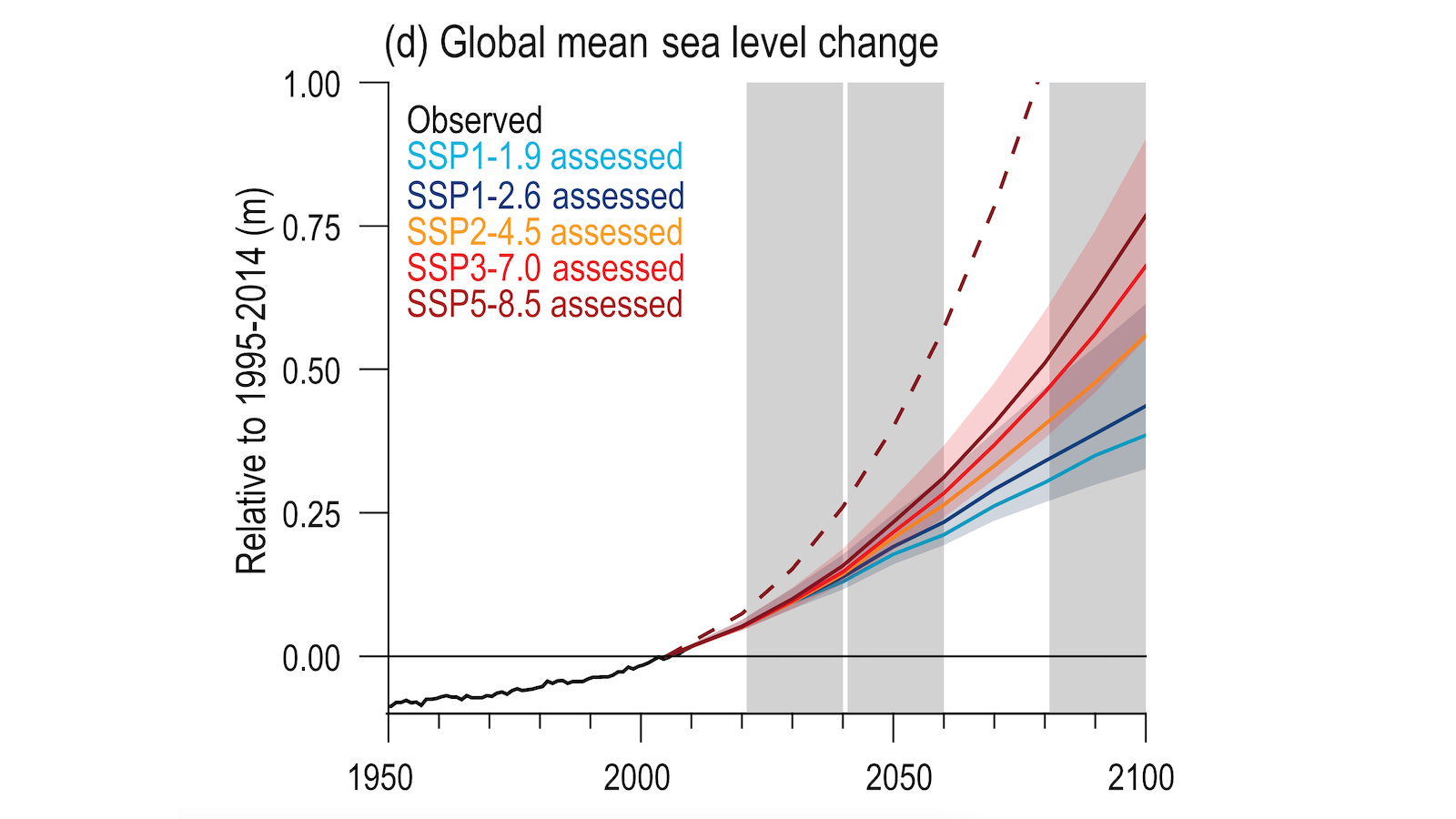
Even though we obviously need to factor in both negative and positive impacts of rising CO2 with precision, most designated experts ignore big positives (e.g., global greening) while catastrophizing negatives (e.g., Gore portrays 20 ft sea level rise as imminent when extreme UN projections are 3ft/100yrs).
If you follow my 3 irrefutable principles for thinking about fossil fuels—factoring in fossil fuels' 1) benefits, 2) climate mastery benefits, and 3) precise negative and positive climate side-effects—the facts show that we need a Fossil Future.
Consider 10 undeniable facts
👇5 undeniable facts about fossil fuels' benefits
1. Human flourishing requires cost-effective energy
2. Far more energy is needed
3. Fossil fuels are uniquely cost-effective
4. Unreliable solar and wind are failing to replace fossil fuels
5. Fossil fuels give us an incredible climate mastery ability
Undeniable energy fact 1: Cost-effective energy is essential to human flourishing
Cost-effective energy—affordable, reliable, versatile, scalable energy—is essential to human flourishing because gives us the ability to use machines to become productive and prosperous.
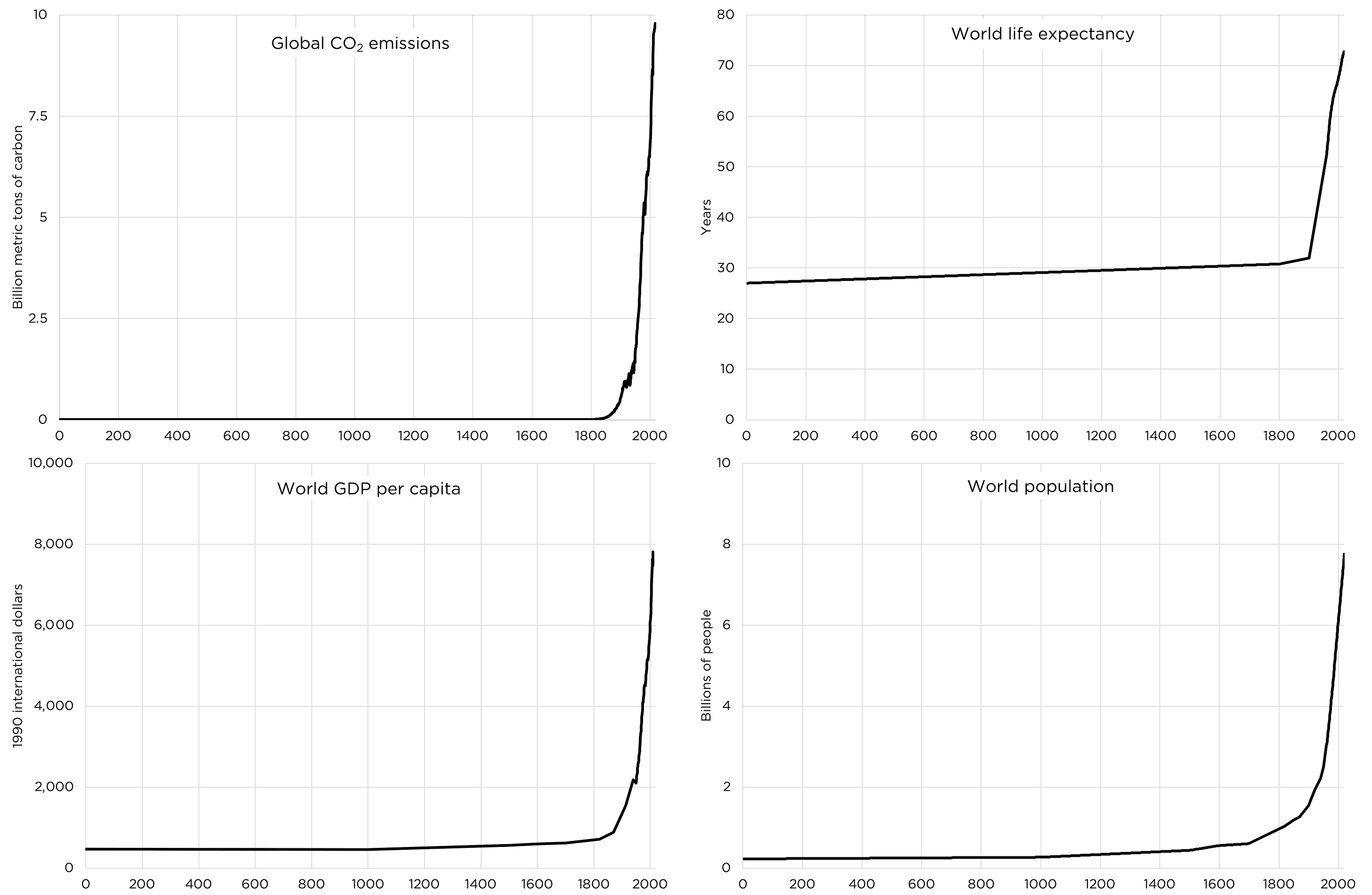
Thanks to today's unprecedented availability of cost-effective energy (mostly fossil fuel) the world has never been a better place for human life. Life expectancy and income have been skyrocketing, with extreme poverty (<$2/day) plummeting from 42% in 1980 to <10% today.¹
Undeniable energy fact 2: The world needs much more energy
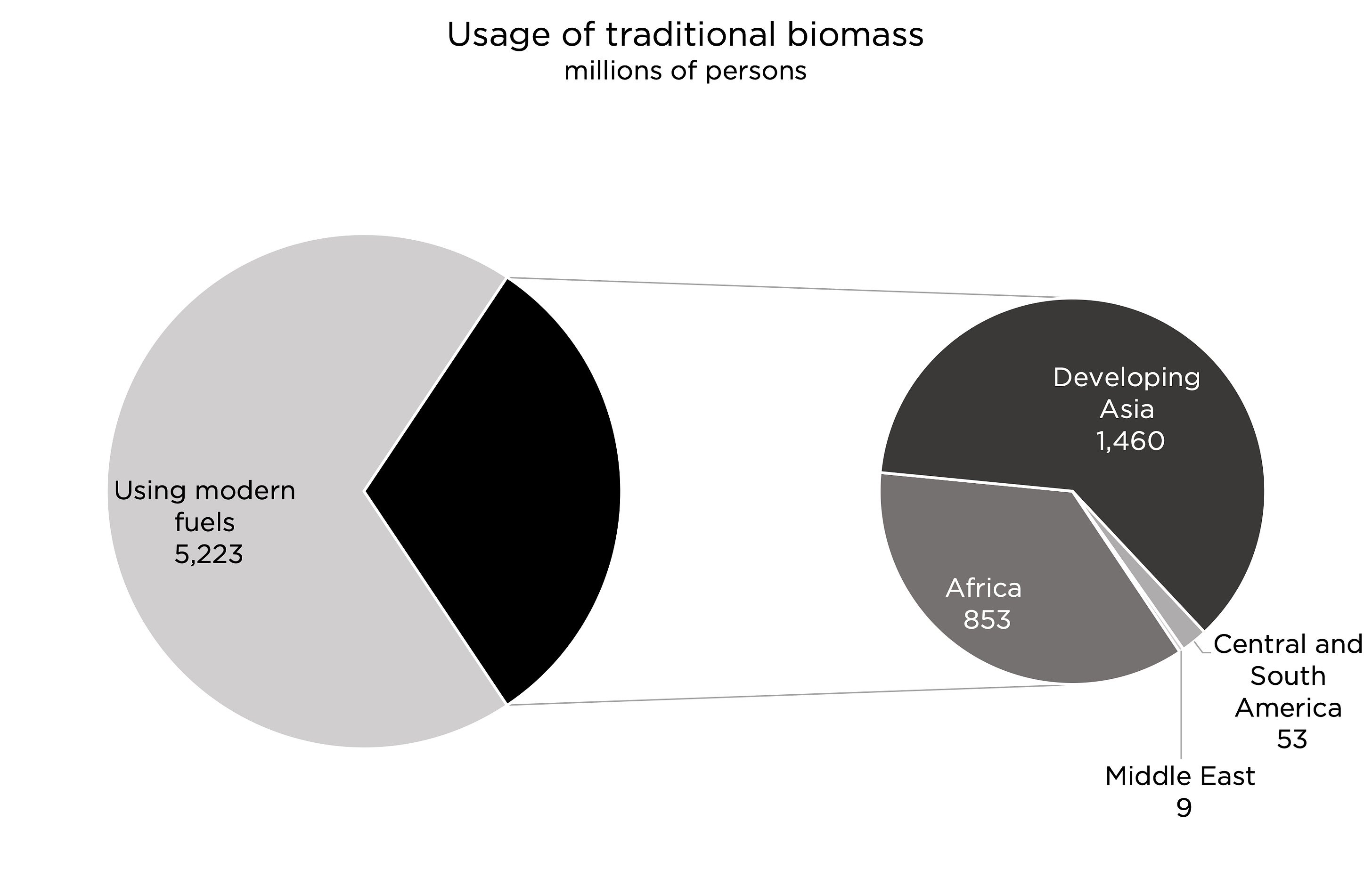
Billions of people lack the cost-effective energy they need to flourish. 3 billion use less electricity than a typical American refrigerator. 1/3 of the world uses wood/dung for heating/cooking. Much more energy is needed.²
The desperate lack of life-giving, cost-effective energy means that any replacement for fossil fuels must not only provide energy to the 2B who use significant amounts of energy today but to the 6B who use far less. Restricting fossil fuels without incredible alternatives is mass-murder.
Undeniable energy fact 3: Fossil fuels are uniquely cost-effective
Despite 100+ years of aggressive competition, fossil fuels provide 80%+ of the world's energy and they are still growing fast—especially in the countries most concerned with cost-effective energy. E.g., China.³
Fossil fuels are uniquely able to provide energy that's low-cost, reliable, and versatile on a scale of billions of people. This is due to fossil fuels' combo of remarkable attributes—fossil fuels are naturally stored, concentrated, and abundant energy—and generations of innovation by industry.
There is currently only one energy tech that can match (actually exceed) fossil fuels' combo of naturally stored, concentrated, abundant energy: nuclear. Nuclear may one day outcompete all uses of fossil fuels, but this will take radical policy reform and generations of innovation + work.
Recent price spikes in fossil fuels do not reflect some new lack of cost-effectiveness on the part of fossil fuels, but rather the devastating effects of "green energy" efforts to artificially restrict the supply of fossil fuels on the false promise that unreliable solar/wind can replace them.
Undeniable energy fact 4: Unreliable solar/wind are failing to replace fossil fuels
Despite claims that solar + wind are rapidly replacing fossil fuels, they provide < 5% of world energy—only electricity, ⅕ of energy—and even that depends on huge subsidies and reliable (mostly fossil-fueled) power plants.⁴
Solar and wind's basic problem is unreliability, to the point they can go near-0 at any time. Thus they don't replace reliable power, they parasite on it. This is why they need huge subsidies and why no grid is near 50% solar/wind without huge parasitism on reliable neighbors.⁵
The popular idea that we can use mostly or all solar/wind with sufficient battery backup is not being tried anywhere because it's economically absurd. Batteries are so expensive that just 3 days of global backup using Elon Musk's Megapacks would cost $400T, >4X global GDP.⁶
For solar/wind to rapidly replace fossil fuels would require magically, immediately fixing their intractable problems providing electricity, then providing the 4/5 of world energy that isn't electricity, then doing that for the world's far greater energy needs going forward.
Unfortunately, there are opportunistic anti-fossil-fuel activist academics who have been feeding the absurd fantasy of rapid global replacement of fossil fuels via unreliable solar and wind. These academics are squarely responsible for today's global crisis of insufficient fossil fuel supply.
All academic schemes to replace fossil fuels with mostly solar/wind share 3 absurd assumptions:
1) schemes never tried anywhere will cheaply work everywhere the 1st time
2) a crash program of unprecedented mining will be cheap
3) today's anti-development politics won't slow anything down
Bottom line: If we recognize the undeniable facts about energy, we must conclude that if 8 billion people are going to have the cost-effective energy they need to flourish, in the far greater quantities needed, fossil fuel use needs to increase. Rapidly restricting it is deadly, period.
The life-or-death benefits of fossil fuels to the ability of 8 billion people to flourish are true regardless of how severe the negative climate side-effects of fossil fuels are. Those who think fossil fuels' CO2 emissions are apocalyptic still should acknowledge that rapid fossil fuel elimination is apocalyptic.
Those of us who recognize the benefits of fossil fuels should be open to evidence of extremely negative climate side-effects of fossil fuels. But once we learn certain undeniable facts about fossil fuels' climate benefits and side-effects the idea of climate apocalypse is totally refuted.
👇
Undeniable energy fact 5: Fossil fuel energy gives us an incredible climate mastery ability
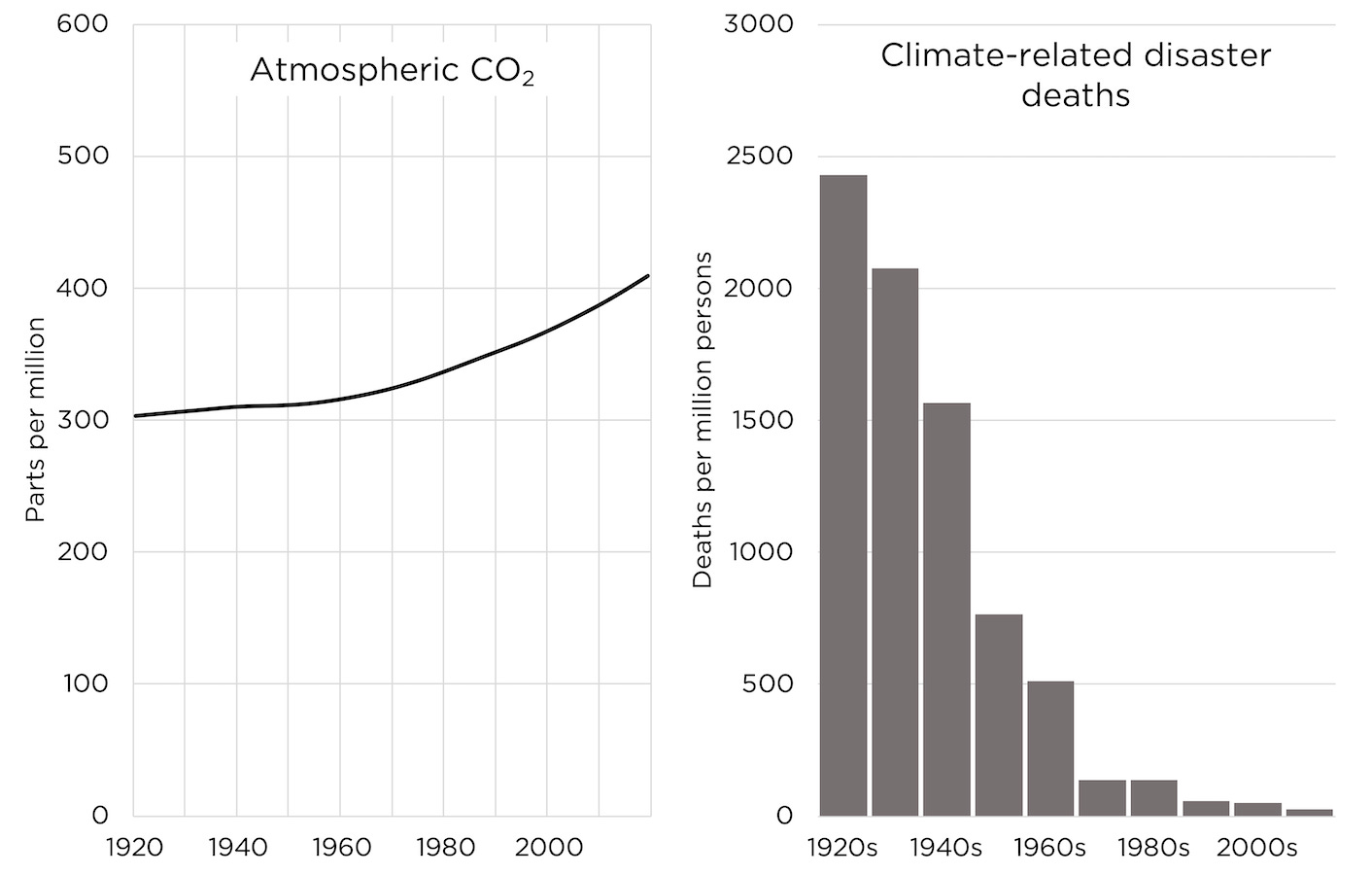
Fossil fuels have helped drive down climate disaster deaths by 98% over the last century by powering the amazing machines that protect us against storms, extreme temperatures, and drought.⁷
Given that fossil fuels give us such amazing mastery over massive natural climate danger, they can give us the same mastery over any manmade climate danger from fossil fuels' CO2 emissions. E.g., if fossil fuels increased drought 10% they could overwhelm that via irrigation and crop transport.
Climate mastery is so powerful that for CO2 emissions to be apocalyptic enough to justify rapid fossil fuel restriction, let alone elimination, they'd need to have unprecedented impacts like:
Seas rising ft per decade
Storms becoming 2X more powerful
Science shows nothing like this.
5 undeniable facts about fossil fuels' climate side-effects
1. CO2 emissions correlate with 1°C warming, + greening
2. Deaths from cold > deaths from heat
3. CO2 warming occurs more in colder places
4. CO2 warming diminishes as levels rise
5. Even IPCC extreme projections are masterable
Undeniable climate fact 1: CO2 emissions correlate with 1°C warming, + greening
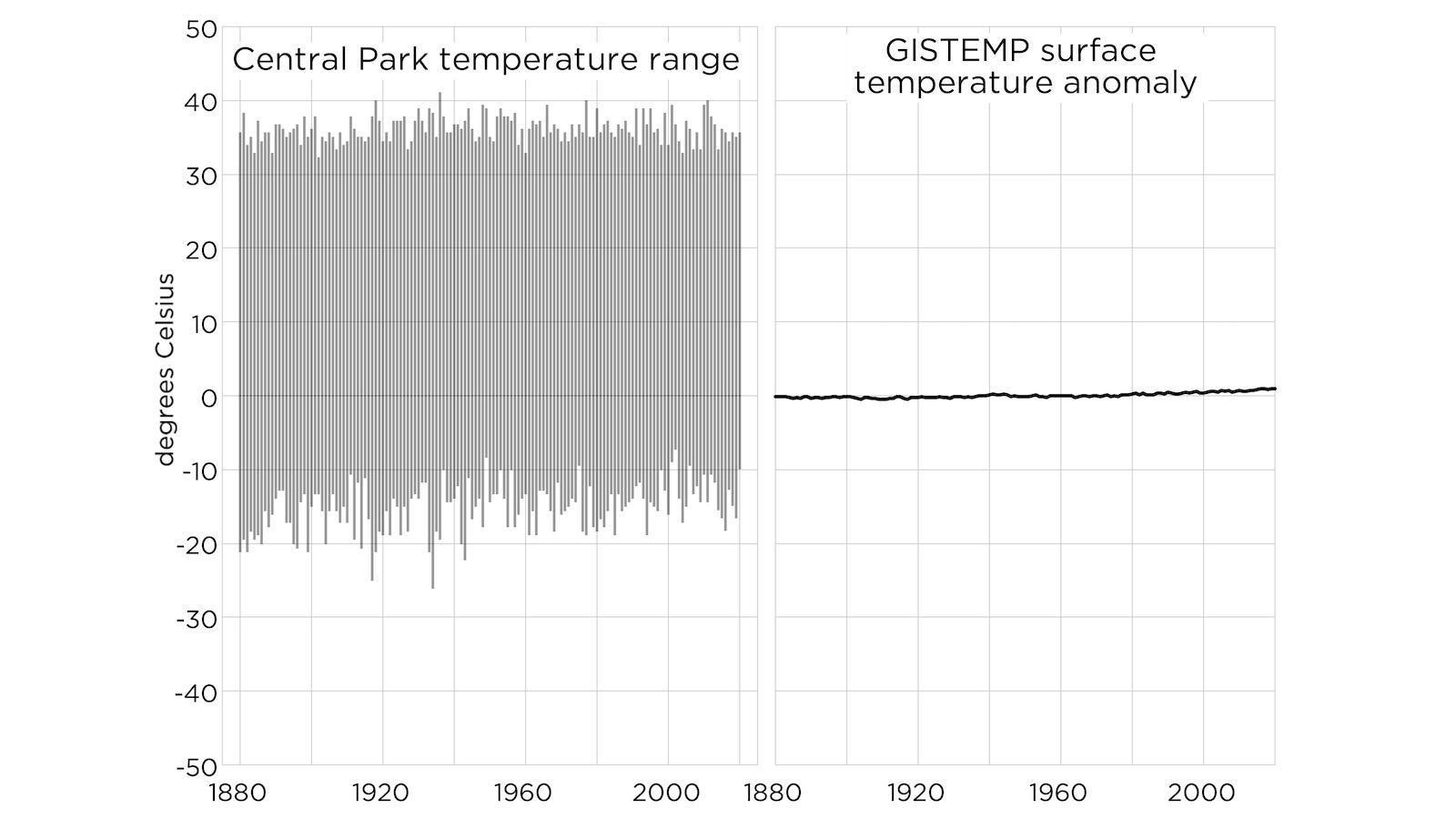
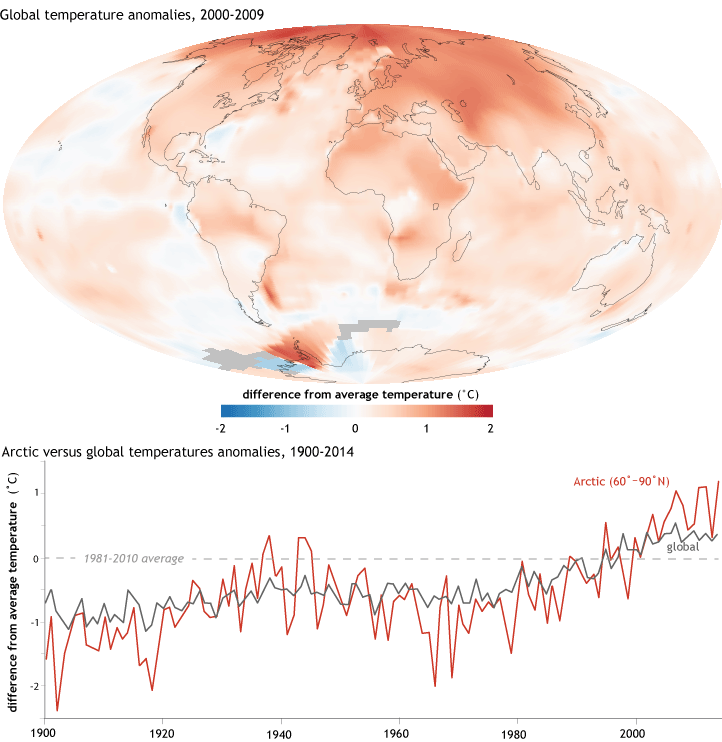
Fossil fuels' CO2 emissions have contributed to the warming of the last 170 years, but that warming has been mild and manageable—1° C. Here's what that looks like compared to normal temp changes.⁸
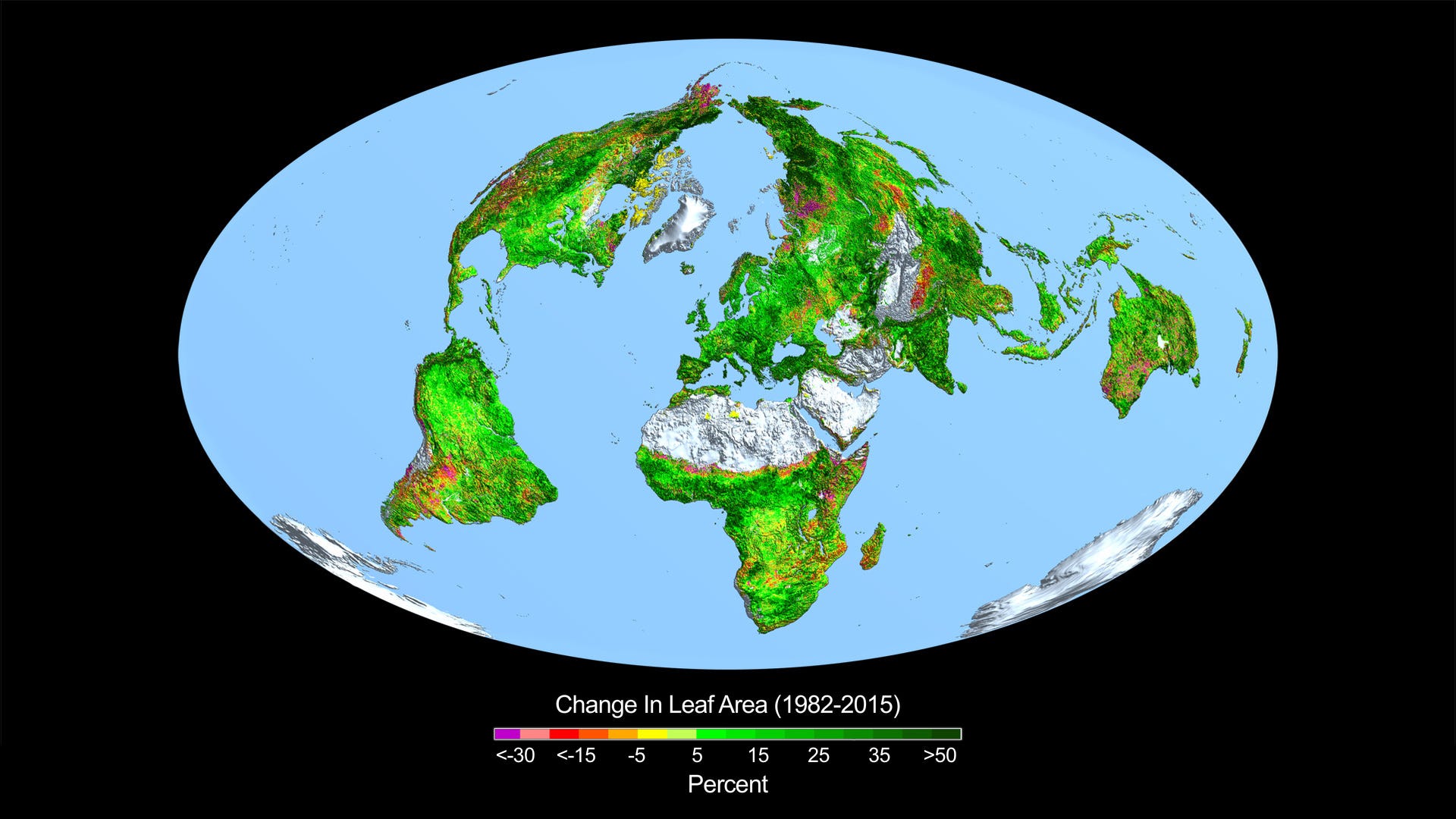
CO2 emissions have also driven significant greening of the planet over the last 170 years, including during this recent 33-year period documented by NASA. This combined with 1° C warming is not remotely catastrophic and is in many ways beneficial.
As for future warming...👇⁹
Undeniable climate fact 2: Deaths from cold far exceed deaths from heat
While leading institutions portray a world as increasingly riddled with heat-related death, the fact is that even though Earth has gotten 1°C warmer far more people die from cold than heat (even in India!).¹⁰
More warming for the foreseeable future is expected to reduce temperature-related mortality on its own. If we factor in the massive temperature mastery benefits that fossil fuels provide we are incomparably better off temp-wise with fossil fuels than without them.
We could drastically reduce temperature-related mortality if more of the people who currently use very little energy became empowered with fossil fuels ASAP. Depriving the poor of fossil fuels would cause countless temp-related deaths in the future.
Undeniable climate fact 3: Warming from CO2 occurs more in colder places
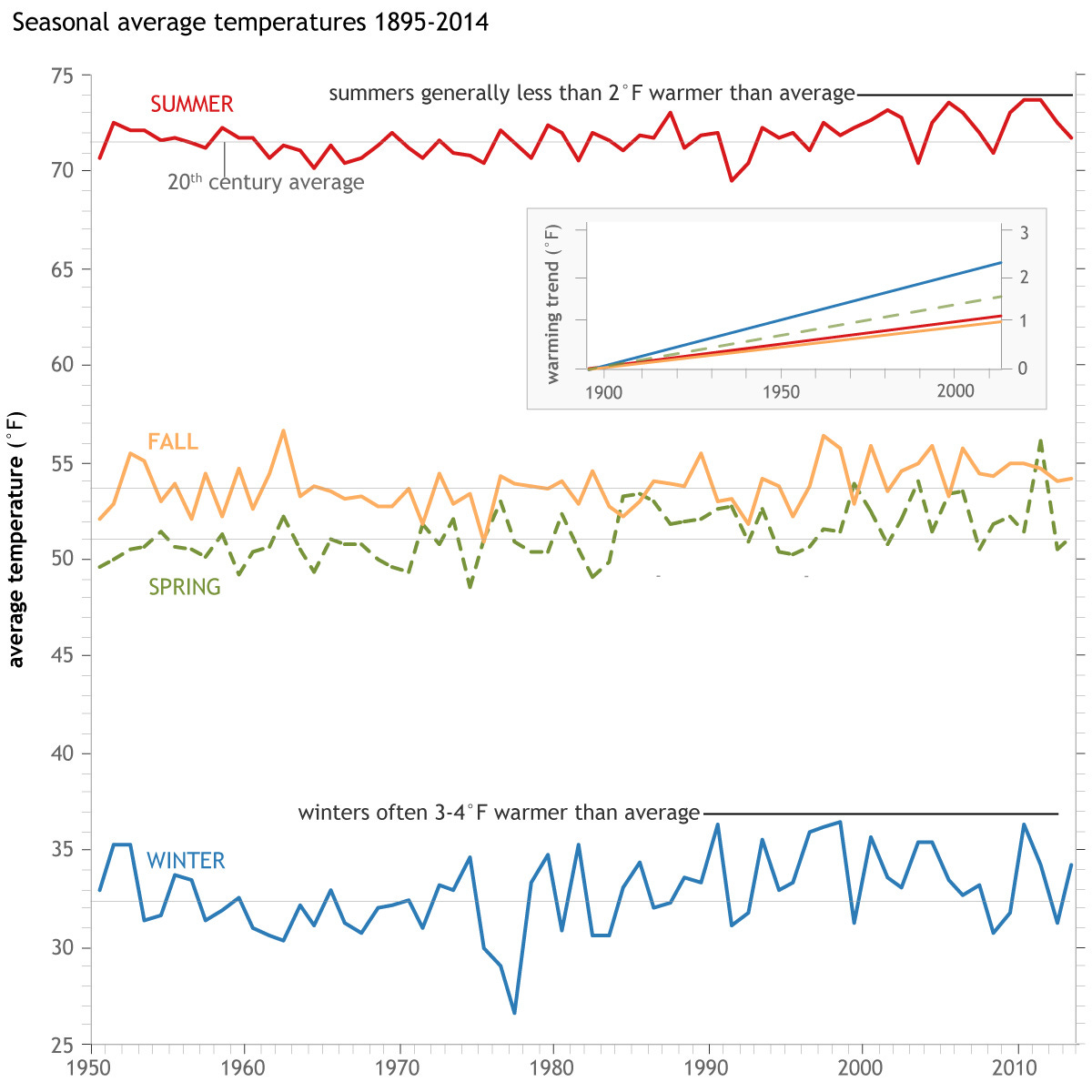
The mainstream view in climate science is that more warming will be concentrated in colder places (Northern latitudes) and at colder times (nighttime) and during colder seasons (winter).¹¹
This is good news.
While we're taught to think of warming as "global" or even concentrated in the hottest parts of the world, it is in fact concentrated in the coldest parts of the world during the coldest times. That makes warming less disruptive and in many cases beneficial.
Especially since…¹²
Undeniable climate fact 4: Rising CO2 leads to diminishing warming
Mainstream climate science is unanimous about a conclusion that the public is, shamefully, not made aware of: the "greenhouse effect" of CO2 is a diminishing effect, with additional CO2 leading to less warming.
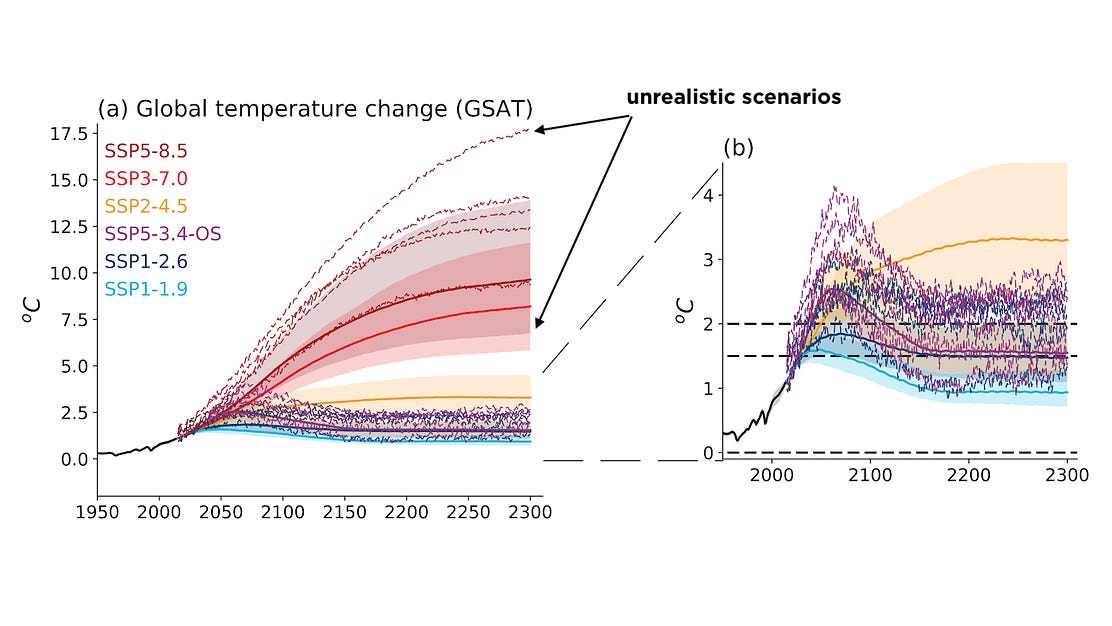
While we're taught to think that warming will accelerate indefinitely as CO2 levels rise, this contradicts the physics of the greenhouse effect (and the history of Earth). That's why even the UN's most extreme scenarios show warming leveling off as CO2 levels rise.¹³
Undeniable climate fact 5: IPCC projected impacts are masterable with fossil fuels
Even the IPCC, with many catastrophist tendencies, projects impacts from warming and associated climate changes that would be masterable with fossil fuels. E.g., storms being 1-10% more intense.¹⁴
The most plausible danger of rising CO2 levels and temps is rapid sea level rises that would destroy coastal investments. But extreme UN projections are just 3 feet in 100 years. Future generations can master that. (We already have 100M people living below high-tide sea level.)¹⁵
Note: the UN IPCC is an extremely flawed, catastrophizing organization. It denies the enormous life-or-death benefits of fossil fuels—most shamefully of all, the climate mastery benefits of fossil fuels that have driven climate-related disaster deaths to all-time lows.
The bottom line with fossil fuels' climate side-effects is that any negatives will continue to be masterable—and there will be benefits such as warming in cold places and continued global greening.
This nowhere near apocalyptic—whereas losing fossil fuels' benefits would be apocalyptic.
Summary: If we look at the undeniable facts about fossil fuels and climate using 3 irrefutable principles for thinking about fossil fuels—factoring in fossil fuels' 1) benefits, 2) climate mastery benefits, and 3) precise negative and positive climate side-effects—we clearly need more fossil fuel.
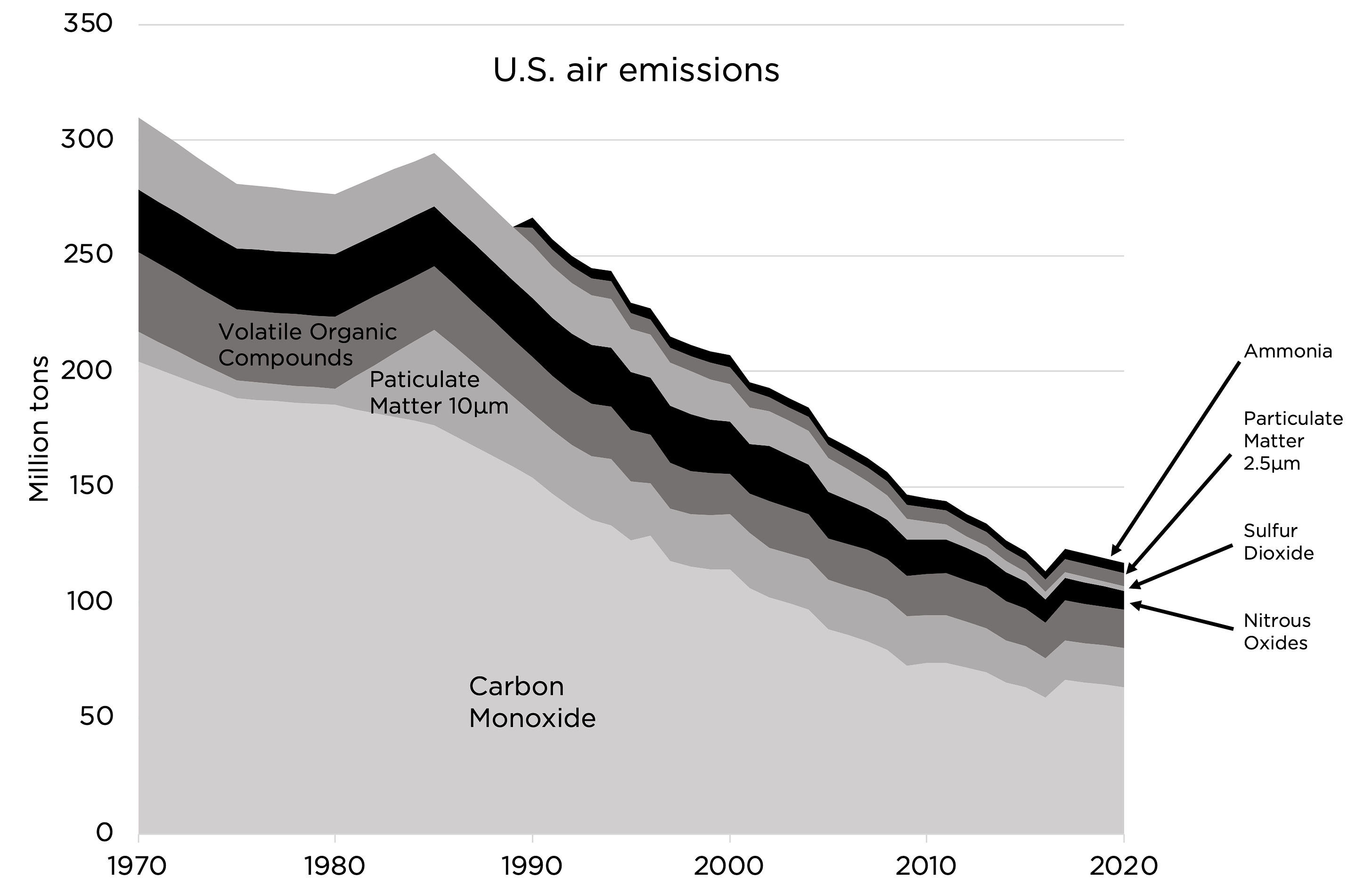
Note: To fully think about the benefits and side-effects of fossil fuels you also must factor in non-climate side-effects, e.g., air/water emissions. I do this in Fossil Future. Bottom line: these are 1) hugely outweighed by benefits and 2) reducible cost-effectively as the US has shown.¹⁶
You might be wondering: Why do our leading thinkers make the errors of ignoring the benefits of fossil fuels and catastrophizing their climate side-effects?
My answer: they accept, sometimes knowingly sometimes not, anti-human assumptions and anti-human values.
The major philosophical reason leading thinkers catastrophize the side-effects of fossil fuels is a false assumption I call "the delicate nurturer": Earth/climate unimpacted by humans exists in a delicate, nurturing (stable, safe, sufficient) balance that human impact ruins.
Insofar as you believe that Earth is a "delicate nurturer," you believe that human beings are "parasite polluters" whose impact on Earth will inevitably lead to disaster. That's why catastrophists keep thinking their next catastrophe prediction will be the one that's right.
The truth is that Earth is not a "delicate nurturer" but "wild potential" (dynamic, deficient, dangerous) and human beings are "producer-improvers" who can impact it for the better. When you recognize this truth you value human impact and expect us overcome problems.
The major philosophical reason leading thinkers ignore fossil fuels' benefits is that their primary moral goal is not advancing human flourishing on Earth but eliminating human impact on Earth. Because fossil fuels' benefits impact Earth a lot they are viewed as unimportant and even bad.
Observe that leading opponents of fossil fuels are not just hostile to fossil fuels but also to nuclear, hydro, and the mining and development involved in solar and wind. Always because of their impact on Earth. Clearly they prioritize eliminating impact over human flourishing.
Realizing that leading thinkers and institutions were driven by anti-human ideas to ignore fossil fuels' benefits and catastrophize their side-effects motivated me as a philosopher to become an energy expert and discover the truth about fossil fuels' benefits and side-effects.
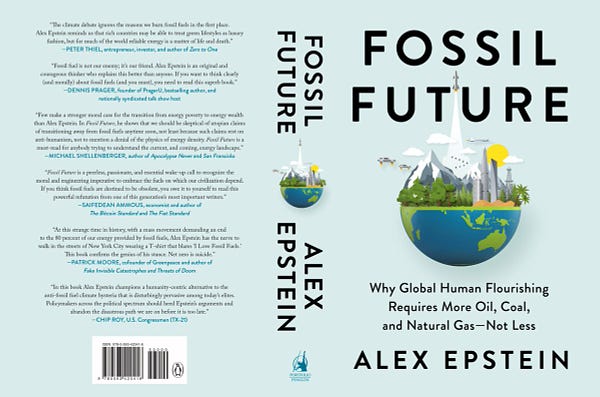
The ultimate synthesis of my 15 years of trying to understand the full benefits and side-effects of fossil fuels is my new, blockbuster book Fossil Future: Why Global Human Flourishing Requires More Oil, Coal, and Natural Gas—Not Less.
If you are a student or educator, you can get a free copy of Fossil Future from Young America's Foundation. Just use this link.
In the 3 months Fossil Future has been out, many people have attacked me personally or tried to straw-man my case. But no one has come close to refuting my case. Because it's based on irrefutable principles and undeniable facts.Here are some of the dozens of endorsements Fossil Future has gotten. But to me the most important endorsements are the daily ones I see from people who say Fossil Future changed their mind on this issue.
To change more minds, please spread the word by sharing this article!
If you're on Twitter, please share my popular thread on this issue.
The irrefutable case for a Fossil Future If we want a world in which all 8 billion of us have the opportunity to flourish—to live long, healthy, prosperous, fulfilling lives—we need to use *more*, not less, fossil fuel going forward. A summary of my book Fossil Future. 🧵👇Popular links
EnergyTalkingPoints.com: Hundreds of concise, powerful, well-referenced talking points on energy, environmental, and climate issues.
My new book Fossil Future: Why Global Human Flourishing Requires More Oil, Coal, and Natural Gas—Not Less.
"Energy Talking Points by Alex Epstein" is my free Substack newsletter designed to give as many people as possible access to concise, powerful, well-referenced talking points on the latest energy, environmental, and climate issues from a pro-human, pro-energy perspective.
If you're on Twitter, please share my talking points there.
The irrefutable case for a Fossil Future If we want a world in which all 8 billion of us have the opportunity to flourish—to live long, healthy, prosperous, fulfilling lives—we need to use *more*, not less, fossil fuel going forward. A summary of my book Fossil Future. 🧵👇Reminder: how to help Fossil Future spread even more
To help my new book Fossil Future spread even more, you can:
Buy one or more copies (obviously)
Spread the word in an email, newsletter, blog or column easily by using or modifying this text. (When you do so, let me know at alex@alexepstein.com.)
Use or edit one of these pre-made social media posts: pre-made Twitter post | pre-made LinkedIn post | pre-made Facebook post.
Share this viral tweet of mine announcing the book.
16"The battery pack portion of it is less than $200/kWh. Power electronics and servicing over 15 to 20 years take the price up to roughly $300/kWh."
Cleantechnica - Tesla Megapack, Powerpack, & Powerwall Battery Storage Prices Per KWhWorld energy consumption is 583.9 Exajoule annually or 4.8 EJ per 3 days ≈ 1,330 TWh (1 EJ ≈ 278 TWh)
1,330 TWh * $300/kWh = $399 trillion.
BP Statistical Review of World Energy 2020Global annual GDP <$100 trillion.
World Bank Data7For every million people on earth, annual deaths from climate-related causes (extreme temperature, drought, flood, storms, wildfires) declined 98%--from an average of 247 per year during the 1920s to 2.5 in per year during the 2010s.
Data on disaster deaths come from EM-DAT, CRED / UCLouvain, Brussels, Belgium – www.emdat.be (D. Guha-Sapir).
Population estimates for the 1920s from the Maddison Database 2010 come from the Groningen Growth and Development Centre, Faculty of Economics and Business at University of Groningen. For years not shown population is assumed to have grown at a steady rate.
Population estimates for the 2010s come from World Bank Data.
89NASA - Carbon Dioxide Fertilization Greening Earth, Study Finds
Regional trends vary, but overall the world's leaf area increased by 5.4 million square kilometers, or an amazon rainforest worth of greening, between 2000 and 2017 alone with over 1/3 of vegetated land showing an increase while only 5% showed a loss of green vegetation.
"Long-term satellite records reveal a significant global greening of vegetated areas since the 1980s, which recent data suggest has continued past 2010. … Global vegetation models suggest that CO2 fertilization is the main driver of global vegetation greening."
Piao, S., Wang, X., Park, T. et al. Characteristics, drivers and feedbacks of global greening. Nat Rev Earth Environ 1, 14–27 (2020)13Even in the extreme, and likely unachievable, emissions scenario leading to 8.5W/m^2 of additional energy influx to the planetary surface (dark red line), temperatures will eventually level off. This scenario requires viable alternatives like nuclear to be unavailable for another century or more while we maintain population and significant economic growth.
Like
© 2022 Alex Epstein
302 Washington St. #150-9385, San Diego, CA 92103
Unsubscribe






Subscribe to:
Comments (Atom)